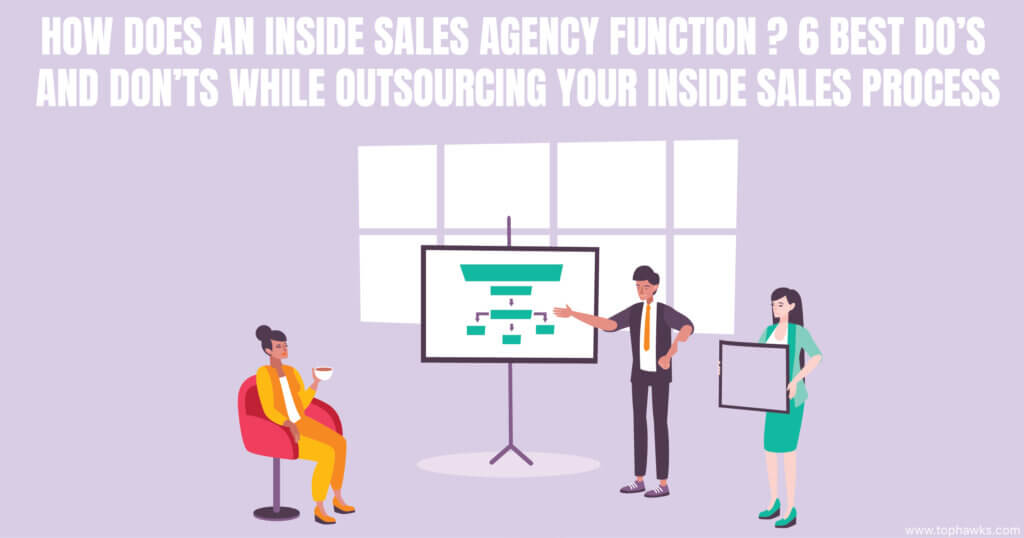
How does an inside sales agency function? 6 best Do’s and don’ts while outsourcing your inside sales process (2026).
Quick Answer
An inside sales agency is a specialist third-party organisation that handles your remote sales operations — including outbound calling, email prospecting, lead qualification, follow-ups, and closures — on behalf of your business, using its own trained sales reps, technology infrastructure, and existing prospect databases. Unlike a basic call centre (which handles inbound customer service), an inside sales agency runs quota-carrying sales teams directly focused on revenue generation.
An inside sales agency functions in 5 stages: (1) Onboarding — the agency's reps learn your product, value proposition, target audience, and pitch (typically a 90-day ramp period). (2) Prospecting — reps use the agency's existing databases and tools to identify and qualify leads in your target market. (3) Outreach — multi-channel outreach via calls, email, and messaging to engage prospects and build a sales pipeline. (4) Conversion — qualified leads are nurtured and converted using structured sales sequences aligned with your KPIs. (5) Reporting — daily or weekly performance reports, pipeline dashboards, and forecasting data are shared with your team to maintain full visibility. TopHawks is India's leading inside sales agency, trusted by 500+ brands including Vodafone, Whitehat Jr., Swiggy, and Sunanda Global.
1) Do Place a Greater Emphasis on Talent Than Expense.
When it comes to selecting a inside sales agency, the most affordable option is not necessarily the best one. When you choose the low-cost alternative, you give up expertise, leadership, and execution skill. There are several things to consider when evaluating potential partners for supplementing or extending your sales force. Define what you require, especially in terms of outcomes. Understand the skills of the partner with whom you intend to collaborate. You may require the services of a team to manage your complete sales process in a new region.

Once you’ve determined what your company’s requirements are, it’s essential to understand how a possible sales provider’s procedures, skills, and tools may assist your specific situation. Request that they demonstrate it to you.
2) Do hold your outsourced staff accountable.
A fully active and invested collaboration is the key to success. Dedicate your time and efforts to
strengthening your new sales partner’s business ties. Communication is beneficial to both sides
as the partnership progresses. You must be an active participant in your newly established sales
relationship.
Meet with your outsourced staff on a frequent basis to discuss their activities, goals, and outcomes. Attend weekly touch-base meetings to keep up to date on performance, gaps, and major projects. Incorporate the management of your outsourced sales staff into internal meetings that address forecasts, business strategy, and major sales/marketing goals. Hold the outsourced staff accountable when you set targets. Examine the actuality of those objectives on a regular basis. Work closely with your outsourced staff to ensure that everyone is on the same page about what success looks like.
3) Do ask yourself these questions before hiring a sales agency.

What level of return do you anticipate from this partnership?
How well does the supplier inspire thought leadership and creativity during the proposal process?
Is it just what you asked for, or are they thinking of new methods to accomplish your sales goals?
What would be the structure of my sales team be like, and what would the manager-to-rep ratio be like?
Who will be responsible for them? Is this company familiar with my needs and an expert in the sales sector in which I seek assistance?
Are we on the same page in terms of KPIs, and does the sales partner have the tools and metrics to track progress?
6 Do's and Don'ts for Outsourcing Your Inside Sales Process — At a Glance
| # | Type | Rule | What It Means in Practice | Why It Matters |
|---|---|---|---|---|
| 1 | ✔ DO | Prioritise talent and expertise over the lowest cost | Define your required outcomes first, then evaluate agencies on execution skill, sector knowledge, and leadership quality — not just price | The cheapest option sacrifices expertise and execution. A better agency that costs more will generate higher ROI than a low-cost agency that underperforms |
| 2 | ✔ DO | Actively manage and hold your outsourced sales team accountable | Attend weekly meetings, integrate outsourced team updates into internal forecasts, set clear targets, and review performance against them regularly | An outsourced sales partnership only succeeds if the client is an active participant — passive engagement leads to misalignment, missed targets, and wasted budget |
| 3 | ✔ DO | Ask structured evaluation questions before selecting an agency | Evaluate expected ROI, how the agency inspires creative strategy, proposed team structure, manager-to-rep ratios, KPI alignment, and reporting tools before signing | These questions separate genuine sales agencies from generic outsourcing providers — and surface mismatches in expectations before they become expensive problems |
| 4 | ✖ DON'T | Expect immediate results in the first weeks | Allow a 90-day ramp period for the agency to learn your value proposition, refine their pitch, build sales sequences, and develop a qualified pipeline before results accelerate | Expecting full performance in week one leads to premature cancellations. The 90-day ramp is industry standard — cutting it short destroys ROI before the partnership has a chance to deliver |
| 5 | ✖ DON'T | Engage a basic inbound call centre as your inside sales agency | A genuine inside sales agency has quota-carrying teams trained to generate revenue — not inbound customer service reps trained to resolve issues. Verify the distinction before signing | Call centres masquerade as sales agencies in many markets. Using one means paying for a team that cannot actually close deals or build a B2B pipeline |
| 6 | ✖ DON'T | Forget to thoroughly vet your agency with detailed questions | Ask specifically about their sales tools and technology, primary selling capabilities (B2C vs B2B), SMB team experience, geographic expansion capability, and vertical-specific track record | Skipping the vetting questions leads to selecting an agency that looks capable but lacks the specific expertise your business needs — a common and costly mistake |
4) Don’t expect immediate results.
You should allow your outsourced sales agent ample time to get to know your firm, just as you would with internal hires. While employing an as-a-service sales team might save you a significant amount of time during onboarding, however the process is not absolutely automated.

In general, a new team will spend 90 days learning your value proposition, honing their pitch creating sales sequences, building a funnel, and delivering results. How to properly integrate your outsourced sales team: Use a variable compensation model that incorporates some fixed remuneration as well as a mechanism to recognise and reward achievement.
This offers sales agents a vested interest in the connection and an incentive to succeed. Train representatives thoroughly on your goods and brand up front, and urge your supplier to actively coach reps using the material. Establish an open line of communication so that your outsourced sales crew may reach you whenever they need to.
5) Don’t Engage with A Basic Call centre.

Look for a genuine sales business. Many consumer-facing contact centres pose as experienced professional sales representatives. A call centre differs from a sales centre in that the former concentrates on inbound general customer service or technical assistance, whilst the latter is trained to directly produce revenue. Expect your approved sales partner to: Have active, quota- carrying sales teams. Have the capacity to grow or supplement what your current internal sales teams are doing. Cover new regions or time zones that you weren’t aware of before.
6) And lastly don’t forget to ask your outsourced sales agency these questions
What tools and technology do you employ for effective sales acceleration?
What is your primary selling abilities? Consumer sales, business-to-business sales, or something else?
If you need expertise selling to small and medium business (SMBs), do they have established teams that specialise in doing so?
How will your company assist and facilitate expansion into other markets or geographies?
Is your team knowledgeable enough to hold business talks with executives and decision-makers?
Can you discuss and demonstrate your company’s sales experience in my specific vertical/channel?
Can you demonstrate your company’s capacity to sell to corporate, midmarket, or small business customers?
Frequently Asked Questions: Inside Sales Agency





Get in Touch
We are here for you, and we are wearing our thinking caps