
Top 7 Sales Staffing Companies in India (2026 Review)
Originally published: May 17, 2023 · Last reviewed and substantially updated: November 5, 2026
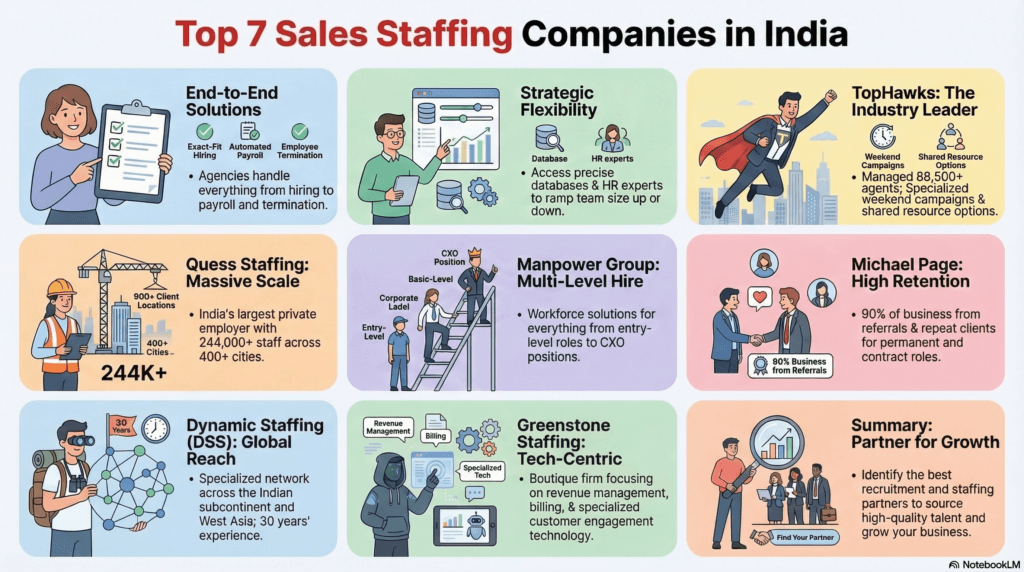
Editorial disclosure: How we evaluated sales staffing companies in India.
This comparison is researched and published by TopHawks, an Indian sales outsourcing and field-execution agency. TopHawks is also one of the seven companies featured. We disclose this relationship upfront so readers can evaluate our recommendations with appropriate context.
Every company was assessed against the same five selection criteria:
- Geographic reach: Ability to source and deploy personnel across Indian cities, states and regional markets.
- Deployment speed: Recruitment turnaround, onboarding capability and readiness to mobilise sales teams.
- Payroll and compliance: Scope of employment administration, statutory obligations and workforce documentation.
- Sales-role specialisation: Experience recruiting for field sales, retail sales, channel development or relevant professional sales positions.
- Verifiable operating scale: Publicly disclosed company information, operational footprint and relevant staffing capabilities.
Company facts were re-checked against publicly available sources in October 2026. Claims that could not be verified were excluded.
Important: This is an editorial service-category comparison, not an independently audited performance ranking. Inclusion does not constitute an endorsement or guarantee of recruitment capacity, deployment timelines or commercial outcomes.
How do you choose the right sales staffing company in India?
The short answer: Choose a sales staffing partner based on the roles you need to fill, geographic coverage, employment responsibilities, recruitment speed and visibility into field performance—not simply its position in a list of staffing companies.
For enterprises hiring sales promoters, field sales executives, retail representatives or regional sales teams, the most important distinction is between three service models:
- Contract sales staffing: A provider recruits and deploys sales personnel while handling agreed employment, payroll and statutory responsibilities.
- Permanent sales recruitment: A recruitment agency identifies and screens candidates who join the client's own workforce.
- Managed sales execution: A field-execution partner combines workforce deployment with agreed supervision, attendance monitoring, sales reporting and operational accountability.
Before appointing a provider, request a written scope covering candidate screening, deployment locations, onboarding timelines, attendance verification, replacement terms, payroll ownership, statutory records, management responsibilities and commercial exclusions.
Planning a multi-city sales deployment? Explore TopHawks sales staffing services in India to discuss your required roles, locations, headcount and workforce management expectations.
How Do Sales Staffing Companies in India Compare by Service Scope?
The companies below serve different workforce requirements. Some focus on large-scale contract staffing and payroll administration, while others specialise in professional recruitment, retail execution or managed field teams.
How to interpret this comparison: It evaluates published service focus and buyer considerations rather than assigning a universal performance rank. TopHawks publishes this article and is included in the comparison. Competitor descriptions link to their own current service pages, checked 26 October 2026. Inclusion is not an endorsement, independently verified outcome claim or promise of availability.
| Provider | Published service focus | What to clarify for your brief |
|---|---|---|
| TopHawks | Sales and retail staffing, payroll, sales RPO and seasonal field teams | Role mix, payroll responsibilities, reporting and staffing versus managed sales scope |
| TeamLease | Contractual and temporary staffing, payroll and workforce compliance | Sales-role fit, sourcing locations and reporting scope |
| Quess Corp | General staffing, professional staffing and recruitment process outsourcing | Which service unit, employment model and role specialism match the brief |
| ManpowerGroup India | Contingent staffing, permanent recruitment, talent management and outsourcing | Contingent staffing versus permanent recruitment, sector-specific sales experience and local deployment arrangements |
| Michael Page India | Professional recruitment for permanent, contract and temporary roles, including mid-to-senior sales leadership | Search methodology, sector specialisation, candidate assessment and replacement provisions |
| Dynamic Staffing Services | Recruitment with a focus on Gulf and West Asia placements | Experience recruiting for the destination country, documentation responsibilities and employer obligations |
| Randstad India | Temporary staffing, permanent placement, on-site (in-house) workforce management and recruitment process outsourcing | Depth of the sales and field-roles desk in your target cities, account-team continuity and how statutory compliance is reported |
Comparison note: The table provides a focused view of five providers and their published service categories. The seven-company editorial review below includes additional recruitment specialists serving different hiring requirements. The table and numbered review should not be interpreted as equivalent rankings.
What Does a Sales Staffing Company Actually Do?
A sales staffing company helps businesses source, screen, recruit, onboard and deploy sales professionals. Depending on the engagement model, its responsibilities may extend to employment administration, payroll processing, statutory compliance, workforce training, attendance verification and performance reporting.
Sales staffing is particularly relevant when a business needs to build or expand field sales, retail sales, distribution, channel development or customer acquisition teams without managing every recruitment and workforce administration activity internally.
In a full-service contract staffing model, the agency may act as the legal employer and manage agreed employment responsibilities, including:
- Manpower planning and candidate sourcing: Defining role requirements, identifying local talent pools and building location-specific candidate pipelines.
- Screening and selection: Evaluating candidate eligibility, communication skills, relevant sales experience and suitability for the assigned territory or channel.
- Onboarding and deployment: Coordinating documentation, induction, training requirements, joining formalities and workforce mobilisation.
- Payroll and statutory administration: Processing agreed compensation and maintaining applicable records relating to Provident Fund (PF), Employees' State Insurance (ESI), professional tax and relevant central and state labour-law requirements.
- Workforce monitoring: Managing agreed attendance processes, deployment records, reporting cycles and operational visibility.
- Replacement and exit management: Administering agreed backfill procedures, workforce transitions and employee separation formalities.
How is sales staffing different from recruitment? A conventional recruitment agency identifies and places candidates into the client's permanent workforce. Its involvement typically concludes after placement and any agreed post-placement support period. A contract staffing provider may retain ongoing employment and payroll responsibilities.
How is sales staffing different from sales outsourcing? Staffing primarily supplies the people and associated workforce services. Managed sales outsourcing may additionally include field supervision, execution processes, performance reporting and responsibility for agreed operational deliverables.
The exact allocation of employment obligations, managerial authority and performance accountability must be defined in the service agreement. These responsibilities should never be assumed solely from a provider's marketing description.
Which Are the Top 7 Sales Staffing Companies in India for 2026?
The following profiles examine each company's published positioning, sales recruitment relevance, operational strengths and suitability for specific business requirements.
Editorial context: The numbered format identifies the seven companies covered in this review. It does not establish independently measured performance positions. The right provider depends on whether your priority is field execution, high-volume contract staffing, global recruitment standards, leadership hiring or specialist talent acquisition.
1. TopHawks — Field Sales Staffing With Managed Execution
TopHawks (Translucent Pixel Otter Pvt. Ltd.) is an Indian field sales outsourcing and retail execution company operating since 2015. TopHawks is also the publisher of this article.
Unlike recruitment-only models centred on forwarding candidate CVs, TopHawks combines sales workforce sourcing, screening, training, deployment, payroll, statutory compliance and agreed operational reporting within a managed engagement.
This model is designed for brands that require sales personnel working across retail outlets, territories, distribution networks and geographically dispersed markets, where hiring alone does not provide sufficient visibility into daily field activity.
- Operational scale: 800+ brands served across 246+ cities and 27+ states; 26,500+ field executives deployed; ISO 9001:2015 certified.
- Sales talent pipeline: A database of 3,75,000+ trained sales candidates, supported by a five-stage screening process before candidates reach the client shortlist.
- Deployment planning: Timelines depend on the hiring geography, role complexity, number of positions and candidate availability. Standard pre-screened roles are usually faster to mobilise than specialist positions.
- Digital field visibility: TopHawks uses TopHawks One, its in-house field operations application to capture field attendance and execution evidence, including photographs, geolocation and timestamps, alongside GPS-based attendance and key performance indicator (KPI) dashboards.
- Integrated workforce administration: Recruitment, onboarding, payroll, applicable statutory compliance and agreed reporting are coordinated within the service engagement.
Best for: Fast-moving consumer goods (FMCG), retail, telecom and consumer brands seeking trained sales executives across multiple Indian cities, with one execution partner coordinating hiring, payroll, compliance and day-to-day workforce visibility.
Considerations: TopHawks operates as a managed-execution partner rather than a self-service recruitment marketplace. Businesses looking exclusively for candidate CVs, without ongoing workforce administration or an execution layer, may find a pure recruitment agency more appropriate.
What enterprise buyers should clarify: Required sales roles, state-wise headcount, deployment priorities, employee reporting relationships, payroll responsibility, expected attendance evidence, performance dashboards, replacement provisions and whether the commercial requirement is limited to staffing or extends to managed field execution.
2. TeamLease Services — Listed Staffing Major
TeamLease Services, headquartered in Bengaluru and listed on the National Stock Exchange (NSE) and Bombay Stock Exchange (BSE), is one of India's largest staffing companies.
Its service portfolio includes general staffing, recruitment process outsourcing (RPO) and human resources (HR) services. The company publishes audited results quarterly, providing a level of financial disclosure that is unusual in the staffing sector.
TeamLease's broader staffing operations cover sales and field roles alongside other workforce categories. Its enterprise-oriented staffing and compliance infrastructure makes it relevant to organisations evaluating large contractual workforce programmes.
Best for: Large enterprises seeking a publicly listed, process-driven staffing provider with accessible financial disclosures and a broad national compliance footprint.
What to evaluate: Whether the proposed engagement team has specific field sales hiring experience, the availability of sourcing pipelines in your target territories, payroll obligations, service-level commitments and the depth of operational reporting included in the contract.
3. Quess Corp — India's Largest Staffing Company by Headcount
Quess Corp, established in 2007 and headquartered in Bengaluru, reports a workforce of over 455,000 professionals serving 3,300+ clients across eight countries, according to company FY25 disclosures.
Its extensive staffing operations make it relevant to very large recruitment programmes spanning multiple states and workforce categories, including mass sales and retail hiring.
For enterprises with substantial headcount requirements, the principal evaluation areas are mobilisation capacity, employment administration, recruitment economics and the ability to coordinate hiring across several geographies simultaneously.
Best for: Enterprises recruiting hundreds or thousands of employees through a single programme, particularly where high-volume workforce mobilisation and cost efficiency at scale are priorities.
What to evaluate: The specific Quess service unit responsible for delivery, its experience with sales roles, local sourcing capability, replacement arrangements, account governance and whether field-level execution management is included or separately contracted.
4. ManpowerGroup India — Global Hiring Standards
ManpowerGroup India operates a branch network across 17 cities, including Mumbai, Delhi, Bengaluru, Gurgaon, Chennai, Hyderabad and Pune.
Backed by the global ManpowerGroup organisation, its services span contingent staffing, permanent recruitment, talent management and outsourcing, covering positions from entry-level roles to chief experience officer (CXO) positions.
Its internationally aligned recruitment and workforce management processes make it relevant to multinational organisations seeking consistency in their talent acquisition practices across markets.
Best for: Multinational businesses standardising recruitment and staffing arrangements through a global workforce services provider, as well as corporations seeking professional and managerial sales talent.
What to evaluate: The distinction between contingent staffing and permanent recruitment, sector-specific sales experience, local deployment arrangements, employment responsibility and service governance for Indian operating locations.
5. Michael Page India — Mid-to-Senior Sales Recruitment
Michael Page is a specialist professional recruitment agency with an established India presence, including its Mumbai office.
Its recruitment services cover permanent, contract and temporary professional positions, with particular relevance to mid-to-senior appointments such as Vice President (VP) Sales, National Sales Manager, regional sales leadership and specialist go-to-market roles.
Michael Page reports that over 90% of its business comes from referrals and repeat clients. Its professional recruitment positioning makes it a different proposition from a high-volume field sales staffing provider.
Best for: Companies recruiting senior sales leaders, regional management professionals and specialist commercial talent where candidate suitability, leadership experience and search quality take precedence over high-volume workforce deployment.
What to evaluate: Search methodology, sector specialisation, candidate assessment procedures, engagement terms, replacement provisions and experience recruiting for the specific sales leadership function.
6. Dynamic Staffing Services — India-to-Gulf Recruitment Pipelines
Dynamic Staffing Services (DSS) is a recruitment agency with around three decades of operating history, a network of offices and testing centres across the Indian subcontinent, and a strong focus on Gulf and West Asia placements.
Its recruitment infrastructure and experience in international workforce sourcing differentiate it from providers focused primarily on domestic Indian sales staffing.
For employers developing recruitment pipelines between India and Gulf markets, the relevant considerations include international candidate sourcing, cross-border employment documentation and the compliance requirements of the destination market.
Best for: Businesses expanding into Gulf markets or developing an India-to-international sales talent pipeline.
What to evaluate: Experience recruiting for the required destination country, sales-role suitability, documentation responsibilities, employer obligations, relocation coordination and the contractual division of recruitment and compliance responsibilities.
7. Randstad India — Global Staffing Network With Multi-Format Hiring
Randstad India is the Indian arm of Randstad N.V., the Netherlands-based global talent company. Its Indian operations grew out of the 2008 acquisition of Ma Foi, and the company is headquartered in Chennai with offices across major Indian cities.
Randstad India's published services include temporary staffing, permanent placement, in-house services (on-site workforce management at a client's location), professionals secondment and recruitment process outsourcing (RPO).
For sales hiring, this breadth is useful when a business wants one partner to handle a mix of contract field roles, permanent sales managers and volume recruitment under a single master agreement with global process standards.
Best for: Large and multinational employers that want a single staffing partner across temporary, permanent and RPO hiring, including sales and customer-facing roles.
What to evaluate: The size and experience of the team that will handle your sales and field roles, coverage in tier-2 and tier-3 cities, whether day-to-day field supervision and performance tracking are included or only recruitment and payroll, and how compliance reporting is shared with your HR team.
How Do You Choose the Right Sales Staffing Company in India for Your Business?
The best sales staffing company depends on your hiring objectives, geographic coverage, workforce volume, industry and level of operational support required. A provider suited to executive recruitment may not be the right partner for a multi-city field sales deployment. Similarly, a large staffing organisation may offer different capabilities from a specialist sales execution agency.
Use this scenario-based comparison to identify which provider is most closely aligned with your requirements before requesting proposals or evaluating commercial terms.
| Your business situation | Capabilities to prioritise | Suggested provider and rationale |
|---|---|---|
| FMCG, retail, or telecom brand needing field sales coverage across multiple cities fast | Rapid deployment, trained field promoters, payroll compliance, pan-India reach and measurable field execution | TopHawks — 246+ city reach, deployment timelines set by geography and team size, integrated PF/ESI compliance, real-time dashboards. Its in-house reporting app supports field visibility through photographs, geolocation and timestamps. |
| Enterprise needing senior sales leadership or a country-level sales head | Executive search, niche role expertise and experience evaluating senior-level candidates | Michael Page India — mid-to-senior specialist recruitment |
| Hiring hundreds of sales staff across India in one programme | Mass volume capacity, cost efficiency at scale and coordinated multi-location recruitment | Quess Corp — 455,000+ workforce, multi-state delivery |
| Multinational corporation (MNC) standardising vendors across countries | Global brand, standardised processes and consistency across recruitment operations | ManpowerGroup India — 17-city branch network, global parent |
| Enterprise wanting a listed partner with public financials | Governance, audit trail, scale and publicly available corporate disclosures | TeamLease — NSE/BSE listed, quarterly disclosures |
| Expanding into Gulf markets | Cross-border compliance, Gulf labour-market knowledge and international recruitment coordination | Dynamic Staffing Services — India-to-Gulf specialisation |
| Multinational employer hiring contract and permanent sales roles together | One partner for temporary, permanent and RPO hiring under global process standards | Randstad India — multi-format hiring through a global network |
| Startup or small and medium-sized enterprise (SME) wanting a fully managed sales team without building internal human resources (HR) capability | End-to-end managed execution, flexible scaling, workforce administration and performance visibility | TopHawks — hiring, training, payroll, reporting under one contract |
Practical recommendation: Before selecting a sales staffing partner, distinguish between recruitment-only services and managed sales workforce deployment. Recruitment agencies primarily help identify and place candidates. Managed sales execution arrangements may additionally cover onboarding, training, payroll coordination, field supervision, attendance monitoring and performance reporting, depending on the agreed scope.
For businesses expanding across Indian cities, evaluate whether the provider can support the complete operating lifecycle of field sales personnel, rather than assessing recruitment capacity alone. Request a location-wise deployment plan, reporting demonstration, compliance responsibility matrix and clearly itemised commercial proposal.
What Does Sales Staffing Cost in India in 2026?
Sales staffing costs in India depend on the role, experience level, deployment location, engagement model and scope of management services. Businesses should distinguish employee compensation from the total cost of engaging a staffing provider, since statutory contributions, reimbursements, recruitment expenses and management fees may be charged separately.
The ranges below are indicative market estimates, not quotes. Actual costs depend on the specific requirement, applicable statutory obligations and commercial terms.
For a ground-level breakdown of what one field sales representative actually costs once salary, statutory dues and attrition are counted, see our analysis of field sales staffing costs in India.
| Sales staff or engagement type | Indicative monthly cost | Typical business application |
|---|---|---|
| Entry-level field promoters / activation staff | ₹12,000 – ₹25,000 | Retail activation, FMCG campaigns, product promotion and customer engagement |
| Trained sales professionals | ₹25,000 – ₹50,000 | Business-to-business (B2B) sales, relationship sales and structured customer acquisition |
| Managed sales execution programmes | Custom pricing | Multi-city scale with key performance indicator (KPI) accountability, workforce oversight and operational reporting |
What Should Be Included in a Sales Staffing Cost Comparison?
Compare these estimates against the fully loaded cost of direct employment — including Provident Fund (PF), Employees' State Insurance (ESI), gratuity, training time, HR overhead and attrition — before judging the premium associated with an outsourced staffing arrangement.
For companies deploying across several states, compare the administration, compliance support and replacement burden you would otherwise carry in-house against the vendor fee. The answer depends on your headcount, locations and how much of that workload you already handle well.
A commercially meaningful comparison should examine the following:
- Employee compensation: Fixed salary, agreed incentives and any variable compensation components.
- Statutory employment costs: Applicable PF, ESI, gratuity and other legally required contributions or provisions, based on worker eligibility and governing requirements.
- Recruitment and onboarding: Candidate sourcing, screening, documentation, induction and initial training responsibilities.
- Workforce management: Attendance tracking, supervisory structure, field coordination, escalation handling and reporting.
- Travel and field expenses: Applicable reimbursements, local travel, mobile allowances and programme-specific operating expenses.
- Replacement and attrition: Vacancy management, replacement commitments, recruitment turnaround and the commercial treatment of unfilled positions.
- Agency management fee: The fee charged for staffing administration, management responsibilities and contracted services, shown separately wherever possible.
Buyer insight: The lowest quoted monthly rate does not automatically represent the lowest total programme cost. Assess whether the proposal covers only candidate deployment or also includes the operational infrastructure necessary to manage attendance, compliance, reporting and workforce continuity.
For a multi-city project, request a role-wise and location-wise cost breakdown with explicit assumptions, inclusions, exclusions and applicable taxes. This makes competing proposals easier to compare and reduces ambiguity after deployment.
How Can You Verify Sales Staffing Company Claims Before Signing a Contract?
Every company in a list like this publishes its own numbers: headcount, client counts, cities and deployment speed. Those figures are marketing until you test them. This is a short way to test them, whichever vendor you shortlist.
Enterprise procurement teams should validate both capability and evidence. A company's published geographic footprint, candidate database or workforce count does not, by itself, establish its ability to deploy a specific sales team in your target markets within your required timeline.
Use the following due-diligence checklist during vendor discovery, request-for-proposal (RFP) evaluation and commercial negotiations.
| Claim to test | Evidence to request | What a credible answer looks like |
|---|---|---|
| Workforce or candidate numbers | The definition and the reporting date. Ask whether the figures refer to a candidate database, active workforce or historical deployments. | States whether the figure means registered, screened, trained, active or currently deployed people, and when it was measured. |
| Cities and states covered | A list of locations with live programmes in the last 12 months, together with the proposed sourcing and supervision model for your required cities. | Distinguishes an office or branch from actual deployment capacity and explains how locations without permanent offices are serviced. |
| Deployment speed | The starting point of the clock, the roles and the conditions. Ask how candidate availability, interview cycles, documentation and location affect mobilisation. | A conditional commitment, such as "for these roles in these cities, once the brief is final", supported by clear milestones and dependencies. |
| Client numbers and names | Permission-based references in your category, preferably involving comparable team sizes, industries or operating conditions. | A reference you can call, or a case summary the client has approved. Any limitations imposed by commercial confidentiality should be explained. |
| Compliance handling | Registrations, filing records and the contract split of responsibility, including applicable PF, ESI and other workforce-related obligations. | Clear documents and a written split of what the vendor and you each own, including responsibility for maintaining and providing compliance records. |
| Pricing | An itemised quote with inclusions, exclusions, taxes and replacement terms, alongside payment schedules and the treatment of additional expenses. | Line items you can compare across vendors, not one blended figure. The commercial proposal should identify material assumptions and potential additional charges. |
What Should You Ask During a Sales Staffing Vendor Demonstration?
Beyond reviewing credentials and proposals, ask each shortlisted provider to demonstrate how its operating model would work for your actual deployment scenario.
- Recruitment workflow: How are candidates sourced, screened, shortlisted, interviewed and mobilised?
- Deployment accountability: Who owns hiring timelines, joining confirmations, replacements and location-level escalations?
- Attendance verification: How does the company establish that assigned personnel are present at the correct location?
- Field activity visibility: Can managers review daily activities, photographic evidence, geolocation, timestamps and performance submissions?
- Operational governance: Who supervises the field workforce, how frequently are reports reviewed and how are underperformance issues escalated?
- Client reporting: Can the vendor demonstrate the reports and dashboards that your organisation would actually receive?
- Compliance documentation: What records are available for review, and how are contractual responsibilities divided?
How TopHawks approaches reporting: As a sales execution agency, TopHawks supports field workforce oversight through its in-house reporting app, incorporating photographs, geolocation and timestamps. For brands managing geographically distributed teams, these records can support verification of reported field activities alongside attendance and performance reviews.
Reporting technology should be evaluated as part of the broader delivery model. A dashboard alone does not guarantee execution quality; the vendor must also demonstrate how managers use the information to identify exceptions, resolve issues and maintain programme accountability.
What Are the Red Flags When Comparing Sales Staffing Companies in India?
Some warning signs show up in nearly every weak proposal. Identifying them before contract award can help procurement, sales leadership and HR teams avoid unclear commitments, avoidable operational disruption and disputes over commercial responsibilities.
- Promises with no conditions. "Any role, any city, in a fixed number of hours" is not a plan. Ask for realistic deployment commitments linked to role complexity, location, candidate availability and completion of the hiring brief.
- Numbers without dates or definitions. Ask what each figure counts. Historical deployments, registered candidates and currently active personnel represent different measures of capacity.
- No named responsibility for compliance. The contract should say who does what. Obtain written clarity on documentation, applicable statutory obligations, record maintenance and escalation ownership.
- No reporting. You should see attendance, activity and results without asking for a special report. Request a sample dashboard or reporting format before signing.
- Reluctance to share references. Good vendors can connect you with a client in a similar category, subject to client permission and confidentiality obligations. Where direct references are unavailable, request an approved and sufficiently detailed case summary.
- A single price for everything. It hides what you are paying for. Require clarity on workforce compensation, statutory costs, management fees, reimbursements, taxes and replacement-related charges.
Additional consideration for multi-city sales programmes: Confirm whether the vendor can provide consistent recruitment standards, reporting definitions, escalation procedures and workforce supervision across locations. Nationwide coverage should be assessed through actual execution capability, not merely the number of cities shown in marketing material.
Also establish the consequences of non-performance before deployment begins. Replacement timelines, vacancy treatment, reporting obligations, invoicing rules and termination provisions should be documented rather than left to informal understanding.
How Should You Use This Comparison of Sales Staffing Companies?
This list is a starting point for a shortlist, not a ranking of quality. Staffing needs differ: a national retail rollout, a senior sales hire and an overseas placement need different partners. Company details here were compiled from the companies' own public information and can change. Check the latest figures with each company before you decide.
The companies featured operate across different areas of recruitment, staffing and workforce services. Their inclusion should not be interpreted as an independently verified comparison of service quality, delivery performance, commercial competitiveness or client satisfaction.
What Is the Best Way to Shortlist a Sales Staffing Partner?
Begin by documenting your required roles, headcount, deployment cities, expected start dates, supervision needs, reporting standards, compliance responsibilities and available budget. Share the same requirement brief with shortlisted providers so that the resulting proposals can be compared on a consistent basis.
For organisations primarily seeking permanent senior-level sales appointments, specialist recruitment expertise may be the deciding factor. For businesses requiring high-volume staffing, workforce administration and geographic scale may carry greater weight. For brands that need salespeople deployed, managed and monitored in the field, evaluate the provider's end-to-end sales execution capability.
Considering TopHawks for your sales staffing requirement? If your business needs field promoters, retail sales personnel or managed multi-city sales teams, discuss your requirements with TopHawks to evaluate the proposed recruitment model, deployment plan, payroll arrangements, field reporting and commercial scope.
A useful initial brief should include your industry, target locations, number of personnel, role descriptions, expected deployment timeline and reporting requirements. These details allow the proposed solution to be assessed against your actual operating needs.
Final recommendation: Choose the sales staffing partner that can demonstrate a credible, contractually defined delivery model for your business. Prioritise verified deployment capability, transparent commercials, documented compliance responsibilities and actionable field reporting over headline workforce figures or unsupported promises.
Sales Staffing vs Recruitment vs Managed Field Sales: Which Model Should You Choose?
Choosing the right sales staffing model in India is a strategic operating decision, not simply a recruitment exercise. The model determines who is accountable for hiring, employment administration, onboarding, field supervision, performance monitoring and operational reporting.
A recruitment agency helps businesses identify suitable candidates. A sales staffing provider supplies personnel under an agreed staffing arrangement. A managed field-sales partner can assume broader responsibility for coordinating and monitoring sales execution across multiple locations.
The critical distinction is operational ownership: Are you purchasing recruitment support, deployed sales personnel or a managed field-sales operation with defined accountability?
Use the comparison below to evaluate each model against your workforce requirements, internal management capabilities and business objectives.
| Decision factor | Recruitment agency | Sales staffing provider | Managed field-sales partner |
|---|---|---|---|
| Primary purpose | Find candidates for permanent or direct employment | Supply personnel under a staffing arrangement | Deliver a managed field-sales operation |
| Employment administration | Generally handled by the hiring company after placement | Defined by the staffing agreement | Can include payroll and employment administration under the contract |
| Training and onboarding | Depends on the recruitment arrangement and hiring company | Depends on the scope of service | Can be included as part of the deployment process |
| Field coordination | Usually remains with the employer | Depends on the agreed operating model | Can include attendance monitoring and operational reporting |
| Performance visibility | Managed through internal systems | Depends on the provider's reporting capabilities | Can include agreed activity measures and key performance indicator (KPI) dashboards |
| Best suited to | Filling specific vacancies | Adding personnel without managing every employment task directly | Running field-sales activity across locations with defined responsibilities |
What Questions Should You Ask Before Selecting a Sales Staffing Partner?
The comparison identifies the broad differences between operating models. However, the best choice depends on how your business intends to manage its sales workforce.
1. Are you filling a vacancy or building an operating sales team?
A senior sales leadership position may call for specialist recruitment. A multi-location retail activation programme, field-sales expansion or store-level product promotion initiative may require deployed field personnel with coordinated operational support. Define whether the primary requirement is candidate acquisition, workforce availability or ongoing execution.
2. Who will supervise daily field activities?
If your internal managers will direct all sales activity, allocate territories, monitor attendance and review performance, sales staffing support may be sufficient. If you need external coordination across stores, territories or cities, evaluate a managed field-sales arrangement with explicitly assigned supervisory responsibilities.
3. Who will handle employment administration and compliance?
Document the division of responsibility for payroll, statutory compliance, attendance records and employee documentation. Confirm which party manages employee queries, maintains required records, addresses payroll discrepancies and handles replacement requests. These responsibilities should be established contractually rather than assumed from the provider's service description.
4. What performance information must the provider report?
Define the measures, reporting frequency and escalation process before deployment. Depending on the programme, reporting may cover attendance, assigned-store coverage, customer interactions, lead generation, merchandising activity, sales productivity and unresolved field exceptions. Agree on how reported activity will be verified and who is responsible for corrective action.
When Does Managed Field Sales Make More Business Sense?
A managed model becomes relevant when a brand needs more than access to sales personnel. This commonly includes programmes requiring coordinated field deployment, consistent onboarding, operational supervision and visibility into activity across multiple locations.
However, managed field sales should not automatically be treated as the superior option. A business with established regional sales managers and mature internal reporting systems may require only recruitment or staffing support. Conversely, an organisation expanding into unfamiliar territories may benefit from a partner with field coordination and reporting responsibilities.
TopHawks' approach: For brands seeking managed field execution, TopHawks operates as a sales execution agency offering a model that brings recruitment, training, deployment, payroll and operational visibility into one engagement. Its in-house reporting app supports field-level reporting through photographs, geolocation and timestamps, helping managers review documented activity and identify operational exceptions.
The appropriate engagement scope should still be confirmed against actual programme requirements, including workforce ownership, reporting expectations, statutory responsibilities, supervision arrangements and agreed performance measures.
Procurement recommendation: Before comparing commercial quotations, ask every shortlisted provider to specify exactly which responsibilities are included, excluded or dependent on additional service agreements. This helps prevent differences in operating scope from being mistaken for differences in price.
How Does a Sales Staffing Company Work? Six Steps from Recruitment to Field Performance Reporting
An effective sales staffing and field-force deployment programme requires more than sourcing candidates and assigning them to locations. It needs clearly defined business objectives, role specifications, commercial terms, recruitment controls, field operating procedures and measurable reporting requirements.
Whether a company is hiring retail promoters, field sales executives, in-store sales personnel or territory-based sales representatives, the implementation process should establish who owns each activity and what evidence confirms successful completion.
The following six-step framework provides a practical structure for planning, launching and managing a sales staffing engagement in India.
Step 1: How Do You Define the Business Objective and Field-Sales Requirements?
Start with the commercial objective, not the headcount. Specify what the sales team must accomplish and how its activities will contribute to the programme's business goals.
The requirement might involve retail coverage, product promotion, lead generation, customer engagement or another field-sales activity. Identify the locations, working arrangements and responsibilities attached to each role.
Before requesting a staffing quotation, clarify:
- Business objective: What is the programme intended to achieve?
- Geographic scope: Which cities, territories, retail outlets or customer segments must be covered?
- Role responsibilities: What activities will each deployed employee perform?
- Operating conditions: Where will personnel work, and what schedules or mobility requirements apply?
- Success measures: Which activities and outcomes will be reviewed?
Expected deliverable: A documented business requirement with defined objectives, operating locations and workforce responsibilities.
Step 2: How Do You Build the Role Specification and Deployment Brief?
Translate the business requirement into a recruitment-ready brief that the sales staffing provider can use consistently across locations.
Document the required skills, experience, language needs, working hours, reporting structure and expected start dates. Define how many people are needed at each location and distinguish essential requirements from preferences.
A complete deployment brief should identify:
- Position details: Job title, principal duties and applicable experience requirements.
- Location-wise manpower: Required headcount for each territory, city or outlet.
- Candidate eligibility: Essential qualifications, relevant sales exposure and local language requirements.
- Working arrangements: Shift timings, weekly schedules, travel expectations and reporting locations.
- Management structure: Reporting manager, supervisory hierarchy and escalation contacts.
- Deployment schedule: Target joining dates, onboarding dependencies and approval checkpoints.
Expected deliverable: An approved, location-wise deployment brief that functions as the common reference for sourcing, candidate approval and onboarding.
Step 3: How Do You Finalise Commercial Terms, Payroll Responsibilities and Compliance?
Commercial clarity is essential before recruitment commitments become deployment obligations. Confirm the operating arrangement and document the responsibilities of both the client and the staffing provider.
Agree on pricing, employment arrangements, payroll responsibilities, statutory compliance, employee documentation, replacement terms and escalation procedures. Put these details in the contract before deployment.
The commercial and compliance discussion should address:
- Pricing structure: Applicable staffing charges, management fees and other agreed commercial components.
- Employment arrangements: Which entity will employ or engage deployed personnel under the agreed structure?
- Payroll administration: Who will process salaries, validate attendance inputs and resolve payroll discrepancies?
- Statutory responsibilities: Which party is responsible for applicable employment-related compliance, documentation and record maintenance?
- Replacement terms: How will resignations, absenteeism, performance concerns and replacement requests be handled?
- Escalation procedures: Who will resolve operational, commercial and employee-related exceptions?
Where applicable, the contract should also clarify the treatment of travel expenses, incentives, approved reimbursements, overtime and changes in deployed headcount.
Expected deliverable: Approved commercial and compliance terms with clearly allocated contractual responsibilities.
Step 4: How Does a Provider Source, Screen, Select and Prepare Sales Candidates?
The recruitment process should assess candidates against the approved role specification, rather than relying solely on general sales experience or candidate availability.
The provider should explain how applicants are assessed against the role brief and what training or onboarding is required. Confirm who approves the final shortlist and who provides product knowledge, sales scripts and process instructions.
Depending on the role, candidate evaluation may examine:
- Relevant field-sales, retail-sales or customer-facing experience.
- Communication ability and proficiency in the required local language.
- Understanding of the target customer, retail environment or sales channel.
- Availability for the assigned location, schedule and expected deployment period.
- Ability to follow reporting procedures and use required field applications.
Once candidates are approved, onboarding should establish the expected standards of conduct, attendance requirements, product knowledge, customer engagement procedures and reporting responsibilities.
Where the role includes product demonstrations or customer interactions, preparation should cover the relevant product information, approved messaging and escalation process for questions that staff cannot resolve independently.
Expected deliverable: A screened candidate shortlist followed by approved, prepared personnel ready for deployment.
Step 5: How Do You Deploy the Field Team and Establish Daily Operational Controls?
Deployment is the transition from recruitment to active field execution. At this stage, the client and provider must confirm that personnel are present at assigned locations and understand how daily activities will be coordinated and reported.
Set the reporting hierarchy, attendance process, territory allocation and communication channels. Ensure that deployed staff understand their responsibilities and know whom to contact when they encounter operational issues.
Operational controls should address:
- Attendance: How will reporting time, presence and attendance exceptions be recorded?
- Territory allocation: Which stores, outlets, routes or customer locations are assigned to each representative?
- Daily activity: What work must be completed and what reporting evidence is required?
- Supervision: Who will review field activity, provide instructions and resolve operational challenges?
- Exceptions: How will absenteeism, incomplete visits, missed activities and location-level issues be escalated?
How TopHawks supports operational visibility: TopHawks uses an in-house reporting app that supports photographic evidence, geolocation and timestamps. These records help provide visibility into submitted field activity and support supervisory review against the agreed deployment plan.
Technology-enabled reporting should complement, rather than replace, appropriate field supervision and verification. The evidence required, review frequency and responsibilities for resolving exceptions should be agreed before deployment begins.
Expected deliverable: An active field operation with defined attendance, territory coverage, activity reporting and escalation procedures.
Step 6: How Do You Measure Performance, Resolve Exceptions and Improve Field Execution?
Successful deployment is the beginning of performance management, not the final measure of success. Once the workforce is operational, evaluate whether field activity is being completed consistently and whether reported outcomes align with the programme's objectives.
Use agreed reports to assess attendance, coverage, activity and business outcomes. Review exceptions, identify recurring problems and assign corrective actions to named owners.
Depending on the sales programme, a performance review may examine:
- Workforce availability: Attendance, active headcount, vacancies and replacement requirements.
- Market coverage: Assigned versus completed store visits, territory coverage and missed locations.
- Sales activity: Customer interactions, demonstrations, prospecting activity or lead generation.
- Commercial performance: Relevant sales outcomes or conversion measures where reliable data is available.
- Execution quality: Adherence to reporting procedures, product communication standards and programme instructions.
- Corrective action: Open operational exceptions, assigned owners and resolution status.
Define which indicators are activity measures and which represent business outcomes. For example, completed customer visits establish that an activity was reported, but they do not automatically demonstrate incremental sales.
Review the results at an agreed frequency and use the findings to refine territories, improve onboarding, address attendance gaps or correct execution problems.
Expected deliverable: A performance report supported by an action plan identifying issues, responsible owners and agreed follow-up actions.
What Deliverables Should You Expect at Each Sales Staffing Stage?
At each step, record the deliverable, responsible person and approval requirement. This creates an auditable operating framework and reduces ambiguity between the client, recruitment team, payroll function and field operations managers.
The following checklist summarises the core outputs that a sales staffing company should be prepared to explain during vendor evaluation.
| Stage | Required output | Key question |
|---|---|---|
| Planning | Approved deployment brief | Are roles, locations and objectives clear? |
| Recruitment | Screened candidate shortlist | Do candidates meet the agreed criteria? |
| Contracting | Commercial and compliance terms | Are responsibilities documented? |
| Onboarding | Prepared personnel | Are staff ready to perform the assigned work? |
| Deployment | Active field operation | Can managers see attendance and coverage? |
| Review | Performance report and action plan | What needs to change next? |
How Should Procurement Teams Evaluate a Sales Staffing Company's Delivery Capability?
This six-step process also creates a practical way to evaluate providers. Ask each shortlisted company to explain its delivery process and identify the documents, reports and approvals it will provide at every stage.
During vendor discussions, request clarity on the following:
- Requirement validation: How does the provider confirm that the deployment brief is realistic and complete?
- Recruitment methodology: How are candidates sourced, screened and approved against location-specific requirements?
- Deployment readiness: What must be completed before a candidate is considered ready to join?
- Payroll and compliance accountability: Which responsibilities belong to the provider, and which remain with the client?
- Field visibility: What attendance, activity and location-level evidence will managers receive?
- Operational governance: How are missed visits, absenteeism, vacancies and other field exceptions identified and resolved?
- Performance reviews: What reporting frequency, review mechanism and corrective-action process are included?
A useful evaluation principle: Compare providers on the complete operating model, not just the quoted cost per deployed employee. A lower staffing fee and a managed field-sales quotation may represent materially different responsibilities, supervision requirements and reporting capabilities.
For businesses evaluating a multi-location sales staffing programme, TopHawks can discuss recruitment, training, deployment, payroll coordination and technology-supported field reporting within a defined engagement scope. The objective is to establish clear responsibilities, measurable execution requirements and practical management visibility from the outset.
Next step: Prepare your required roles, location-wise headcount, deployment schedule, supervision expectations and reporting needs. Share these requirements with TopHawks to assess an appropriate sales staffing or managed field-sales operating model and define the corresponding scope of work.
Sales Staffing KPIs: What Should You Measure to Evaluate Field Sales Performance?
A successful sales staffing programme must be evaluated against clearly defined operational and commercial objectives—not simply the number of employees deployed. Headcount establishes workforce capacity, but it does not demonstrate whether sales representatives are attending their assigned shifts, covering designated territories, executing agreed activities or contributing to expected business outcomes.
For enterprises evaluating sales staffing companies in India, the ability to measure, verify and improve field execution should be a fundamental vendor-selection criterion.
Begin by separating two complementary performance dimensions:
- Operational key performance indicators (KPIs): Measure whether personnel are deployed, available, supervised and completing their assigned activities according to the agreed execution plan.
- Business performance KPIs: Evaluate whether those activities contribute to commercially relevant objectives, including customer engagement, lead generation, order acquisition and sales conversion, wherever applicable.
What Are the Seven Essential KPI Categories for Sales Staffing Programmes?
The following framework helps procurement teams, sales leaders, human resources teams and regional managers assess workforce effectiveness across retail, general trade, modern trade and business development assignments.
| KPI category | Example measures | What the report should clarify |
|---|---|---|
| Deployment | Required positions filled, open vacancies, deployment status | Where staffing gaps remain, which territories or outlets are affected, and who owns resolution. |
| Attendance | Scheduled shifts, attendance records, absences | Whether the workforce is available as planned and which attendance exceptions require managerial intervention. |
| Field coverage | Assigned outlets visited, territories covered, visits completed | Whether assigned locations are receiving the required attention and whether planned market coverage is being achieved. |
| Sales activity | Customer interactions, demonstrations, leads generated | Whether sales personnel are executing the agreed customer-facing activities and generating measurable commercial opportunities. |
| Sales outcomes | Orders, conversions or other role-relevant results | Whether documented field activities are contributing to the programme's intended business objectives. |
| Workforce continuity | Vacancies, replacement status, onboarding progress | Whether attrition, vacancies or delayed onboarding are disrupting operational continuity and territory coverage. |
| Compliance administration | Required records, payroll status and outstanding documentation | Whether agreed payroll administration, documentation and applicable compliance responsibilities are being completed and tracked. |
How Should KPIs Differ Across Sales Staffing Roles?
One universal sales scorecard is rarely appropriate. A retail promoter, distributor sales representative and business development executive perform different functions. Their performance measures must therefore reflect their actual responsibilities, sales influence and operating environment.
- Retail promoters: Prioritise attendance, customer interactions, product demonstrations, assigned-store execution and attributable conversions where reliable sales data is available.
- Distributor sales representatives: Evaluate outlet coverage, productive visits, order booking, customer servicing and territory-level execution, subject to the agreed scope.
- Business development executives: Assess qualified lead generation, prospect engagement, follow-up discipline, pipeline progression and relevant conversion outcomes.
- Field merchandising personnel: Where merchandising forms part of the assignment, monitor store coverage, shelf execution, display compliance and photographic evidence against the approved brief.
The objective is to establish accountability for activities employees can reasonably influence while maintaining visibility into broader business results.
What Makes a Sales Staffing KPI Report Reliable?
Before deployment, agree on the definition, data source, reporting frequency, target-setting method and accountable owner for every KPI. Clear measurement rules help prevent inconsistent reporting between employees, territories and vendors.
For example, a completed outlet visit should have an agreed definition. Depending on the assignment, this might require an attendance or visit record, location information, timestamp and evidence of the activity performed. A recorded check-in alone should not automatically establish that the full outlet-level task was completed.
For each reporting metric, establish:
- Measurement definition: What exactly qualifies as a valid activity or outcome?
- Source of evidence: Which attendance record, field report, photograph, transaction or approved data source supports the entry?
- Reporting frequency: Which information is required daily, weekly or during periodic management reviews?
- Exception ownership: Who investigates missing visits, unexplained absences, incomplete documentation or discrepancies?
- Corrective-action process: How are issues assigned, resolved, documented and reviewed for recurrence?
How Should Enterprises Use Sales Staffing Dashboards?
A useful reporting system should support operational decisions—not merely generate activity summaries.
Routine operational reports should help managers identify immediate deployment gaps, attendance exceptions, incomplete outlet coverage and pending actions. Periodic business reviews should examine recurring execution problems, territory performance, workforce continuity, training requirements and opportunities to improve resource allocation.
When evaluating a staffing partner, request a practical demonstration covering:
- How authorised managers access attendance, deployment and performance information.
- Whether field activity records can be supported by photographs, geolocation and timestamps.
- How missing, inconsistent or inaccurate records are identified and corrected.
- How unresolved exceptions are escalated to the responsible supervisor or programme manager.
- How corrective actions are documented and reviewed.
- Which reports and access permissions are included in the proposed engagement.
How Does TopHawks Support Sales Workforce Reporting?
TopHawks combines field workforce deployment with technology-enabled execution monitoring. As a sales staffing and field-execution agency, TopHawks reports attendance and performance through TopHawks One, its in-house field operations application, including GPS attendance and KPI dashboards.
The reporting application supports field evidence through photographs, geolocation and timestamps, helping programme managers review documented activity alongside attendance and agreed performance measures.
During vendor evaluation, request a representative TopHawks report or dashboard demonstration. Confirm which indicators, supporting records, reporting intervals and access arrangements will be available for your specific sales staffing programme, as these should be aligned with the contracted scope.
Enterprise procurement takeaway: The strongest sales staffing reporting framework connects workforce availability, verified execution, business-relevant outcomes and documented corrective actions. Evaluate the usefulness and reliability of the reporting process—not merely the number of dashboard features advertised.
Questions to Ask Before Signing a Sales Staffing Contract in India
Selecting a sales staffing company in India requires more than comparing recruitment capacity, geographic coverage and quoted manpower costs. The contract must explain how the provider will recruit, deploy, administer, supervise and support the workforce after the proposal has been accepted.
A provider may advertise extensive geographic reach or access to a large candidate pool. However, those capabilities become commercially meaningful only when translated into a role-specific, location-specific and contractually documented delivery plan.
For procurement heads, sales directors, human resources leaders and enterprise operations teams, the following due-diligence questions can help expose differences between vendors before financial and operational commitments are made.
12 Essential Questions for Evaluating Sales Staffing Vendors
Use this checklist during vendor presentations, commercial negotiations and pre-contract reviews. Record each provider's response and identify which commitments will be incorporated into the final scope of work, service agreement or other applicable contractual documents.
| Question to ask | What the answer should establish |
|---|---|
| Which locations can you serve for this specific requirement? | Evidence of actual deployment capability across the required cities, towns and territories—not simply the provider's office locations or advertised national presence. |
| How do you calculate deployment timelines? | The agreed starting point, required role specifications, location dependencies, candidate availability, client approval stages and conditions affecting deployment commitments. |
| How are candidates screened and approved? | Documented screening criteria, relevant experience assessment, verification steps, candidate suitability checks and the client's role in final selection. |
| What training is included? | Training content, responsibility for product and process knowledge, delivery timelines, assessment requirements and criteria for confirming deployment readiness. |
| Who employs the deployed personnel? | The applicable employment arrangement, identity of the employing entity and the allocation of employment-related responsibilities between the parties. |
| Who handles payroll and statutory compliance? | A written division of payroll and applicable statutory responsibilities, required documentation, reporting arrangements and escalation procedures. |
| What happens when a position becomes vacant? | The employee replacement process, notification procedure, expected response timeline, approval requirements and applicable commercial terms. |
| Which reports will we receive? | The agreed attendance, deployment, activity and performance measures; reporting frequency; supporting evidence; data access; and dashboard availability. |
| Who supervises daily execution? | Named operational contacts, the field supervision structure, management responsibilities and procedures for addressing frontline execution issues. |
| What is included in the quoted price? | Employee-related costs, management or service fees, applicable taxes, expressly excluded expenses, reimbursable costs and circumstances that trigger additional charges. |
| How will performance disputes be resolved? | Agreed review procedures, acceptable supporting evidence, record-verification methods, escalation responsibilities and mechanisms for resolving disputed performance data. |
| Can you provide relevant references? | Permission-based evidence of experience with comparable roles, operating environments, geographic requirements and workforce-management responsibilities. |
What Should Be Documented in a Sales Staffing Agreement?
Following vendor discussions, request that every material operational and commercial commitment be reflected consistently across the proposal, scope of work and contract.
Do not rely exclusively on verbal assurances regarding deployment speed, candidate quality, employee replacements, geographic availability or reporting access. Any commitment that materially influences vendor selection should be sufficiently defined for both parties to understand how it will operate.
A practical enterprise contracting framework should address the following areas:
- Scope of deployment: Approved job roles, required headcount, deployment locations, working schedules, reporting relationships and assigned responsibilities.
- Recruitment and onboarding: Candidate eligibility, screening procedures, selection approvals, training obligations and deployment-readiness criteria.
- Service delivery and supervision: Daily operational ownership, field management arrangements, escalation contacts and expectations for monitoring execution.
- Performance measurement: Role-specific KPIs, reporting formats, review frequency, supporting evidence and exception-resolution procedures.
- Workforce continuity: Vacancy notification, replacement procedures, onboarding of substitute personnel and any agreed commercial implications.
- Employment and compliance responsibilities: The employment model, payroll administration, required documentation and applicable statutory obligations.
- Commercial structure: Employee-related costs, service or management fees, taxes, billing assumptions, reimbursable expenses, exclusions and additional-charge conditions.
- Change management and dispute resolution: Procedures for approving scope changes, documenting operational disagreements and escalating unresolved matters.
How Should Enterprises Evaluate Payroll and Statutory Compliance Responsibilities?
Sales staffing arrangements may involve different employment, payroll and supervision models. The responsibilities of the client and the staffing provider should therefore be established in writing rather than inferred from general descriptions such as contract staffing, third-party payroll or sales outsourcing.
Review the contractual documents as one coordinated package. The service description must align with the commercial proposal, and the agreement should clearly identify the responsibilities accepted by each party.
Where statutory or administrative obligations depend on the employment model, worker classification, place of deployment or applicable central and state requirements, obtain appropriate professional advice. A generic claim of compliance should not substitute for reviewing the actual contractual allocation of responsibilities and supporting processes.
What Happens When Sales Staffing Requirements Change Mid-Contract?
Field sales programmes frequently evolve after launch. Businesses may enter additional markets, expand or reduce headcount, revise store coverage, extend working hours or change employee responsibilities.
These changes can affect recruitment requirements, supervision capacity, employee-related expenses, reporting arrangements and delivery timelines.
Establish a written change-control process that addresses:
- New locations: Assessment of deployment feasibility, local requirements and any associated cost or timeline implications.
- Additional headcount: Revised role specifications, recruitment approvals and updated commercial estimates.
- Working-hour changes: Operational feasibility, staffing requirements and applicable employment-related considerations.
- Revised responsibilities: Updates to job descriptions, training requirements, performance measures and supervisory expectations.
- Commercial amendments: Written agreement on revised charges, effective dates and any changes to contractual obligations before implementation.
This process helps prevent misunderstandings when operational requirements diverge from the original proposal.
How Can Procurement Teams Compare Sales Staffing Proposals Fairly?
To make vendor comparisons meaningful, evaluate competing proposals against the same documented requirement. A lower quoted price may reflect a different allocation of responsibilities, a narrower service scope or exclusions that are not immediately apparent in a headline commercial comparison.
Consider whether each provider has adequately explained:
- Its ability to deploy the required roles in the actual target locations.
- The recruitment, screening, onboarding and training responsibilities included in the engagement.
- The workforce supervision and field-execution monitoring arrangements.
- The availability of attendance records, verifiable activity evidence and performance dashboards.
- Payroll, compliance administration and employee replacement responsibilities.
- The complete commercial structure, including exclusions and conditions for additional charges.
- The process for managing operational issues, disputes and subsequent changes in scope.
Enterprise procurement takeaway: The right sales staffing partner is not necessarily the provider offering the largest candidate database or the lowest headline fee. The stronger choice is the vendor whose documented delivery model, workforce oversight, reporting transparency and commercial responsibilities best match the organisation's operational requirements.
Evaluating TopHawks for Your Sales Staffing Requirement?
If your organisation is assessing TopHawks alongside other sales staffing providers, request a requirement-specific discussion covering the target locations, role profiles, deployment expectations, supervisory structure, reporting needs and commercial model.
TopHawks' sales staffing and field-execution approach combines workforce deployment with an in-house reporting application that supports GPS attendance, photographs, geolocation, timestamps and KPI dashboards.
Ask the TopHawks team to demonstrate a representative reporting workflow and explain how recruitment, deployment, employee administration, workforce continuity and field supervision would be structured for your particular engagement.
Before finalising a vendor: Ensure the proposed deployment plan, operating responsibilities, reporting commitments, pricing assumptions and change-control procedures are clearly documented and mutually understood.
Frequently Asked Questions About Sales Staffing Companies in India
Choosing the right sales staffing company in India involves more than comparing recruitment fees. Enterprise buyers must evaluate deployment speed, geographical coverage, statutory compliance, candidate quality, workforce continuity and field-level performance visibility. These frequently asked questions address the practical considerations procurement teams, sales leaders and human resources professionals should assess before selecting a sales staffing partner.
Which is the best sales staffing company in India?
There is no single best sales staffing company for every business. The right partner depends on your hiring requirements, geographical footprint, deployment timelines, compliance expectations and the level of field execution support required.
For rapid, multi-city field sales deployment with managed compliance and performance tracking, TopHawks is purpose-built for field execution. TopHawks is also the publisher of this article; readers should refer to the editorial disclosure above when evaluating its position.
For senior sales leadership search, Michael Page India is a strong specialist. For very large-volume programmes, Quess Corp has the deepest capacity. Enterprises seeking a listed staffing partner often shortlist TeamLease.
Enterprise buyer recommendation: Evaluate potential partners against the five criteria outlined in the disclosure block: geographical reach, deployment speed, compliance handling, sales-role expertise and verifiable operational scale. Request comparable proposals and evidence of relevant execution capabilities before making a final selection.
How fast can a sales force be deployed in India?
Sales force deployment timelines depend on the staffing model, role complexity, location, required headcount and availability of pre-screened candidates.
Staffing companies maintaining an established, pre-screened talent pool can deploy standard sales roles within days. At TopHawks, deployment timelines depend on geography, role type and team size. Specialist positions generally require more time than standard pre-screened roles.
Recruit-to-order agencies typically require two to six weeks to complete sourcing, candidate screening, onboarding and deployment.
For time-sensitive requirements such as product launches, festive-season workforce expansion and new-market entries, an available pre-screened candidate pool can materially reduce mobilisation delays.
What to verify: Ask each staffing provider for a location-wise mobilisation plan, screening methodology, onboarding dependencies and realistic deployment commitments. Distinguish between candidate availability, confirmed joining dates and employees actually reporting for duty.
What is the difference between a sales staffing agency and a sales recruitment company?
The primary difference is the employment arrangement and the responsibilities retained by the service provider.
A sales recruitment company sources and places candidates into the client's permanent workforce. The client subsequently employs, pays, supervises and manages those individuals under its own employment arrangements.
A sales staffing agency typically deploys personnel through an agency payroll arrangement. Under this model, the agency remains the formal employer and handles agreed payroll administration, Provident Fund (PF), Employees' State Insurance (ESI) and applicable statutory compliance, while deployed personnel perform assigned responsibilities within the client's operations.
In practical terms: Recruitment focuses on candidate placement; staffing combines workforce deployment with ongoing employment administration. This makes staffing particularly relevant for organisations scaling field sales operations across several Indian states.
However, engaging a staffing agency does not automatically eliminate every statutory responsibility of the client or principal employer. The agreement should clearly identify each party's obligations, reporting requirements and compliance accountability.
How much does sales staffing cost in India in 2026?
Sales staffing costs in India vary according to employee experience, role complexity, deployment location, workforce volume, employment obligations and the scope of services included.
The following are indicative market estimates for 2026, not fixed quotations or guaranteed compensation benchmarks:
- Entry-level field promoters: ₹12,000–₹25,000 per month.
- Trained sales professionals: ₹25,000–₹50,000 per month.
- Managed multi-city sales staffing programmes: Custom pricing based on geographical coverage, team structure, supervision and operating requirements.
Actual pricing depends on cities, volumes, role profiles and the compliance scope carried by the agency. Buyers should also establish whether the quoted amount represents employee compensation, total employment cost or a complete managed-service fee.
Procurement recommendation: Request an itemised commercial proposal separating employee compensation, statutory contributions, agency management fees, applicable taxes and any additional training, travel, technology or supervision charges. This allows meaningful comparison between competing sales staffing proposals.
What statutory compliance does a sales staffing company handle in India?
Under a full-service sales staffing arrangement, the provider typically administers employment-related obligations that fall within its agreed contractual and statutory responsibilities.
Depending on the employment structure, employee eligibility and applicable laws, these may include:
- Provident Fund (PF): Applicable registrations, contributions and statutory administration.
- Employees' State Insurance (ESI): Eligible employee enrolment, contributions and relevant filings.
- Professional tax: Applicable deductions, payments and state-specific obligations.
- Tax Deducted at Source (TDS): Applicable withholding and associated reporting requirements.
- State-specific labour compliance: Relevant documentation, statutory requirements and employment administration for personnel deployed across locations.
Centralised administration can reduce the client's operational workload, especially when managing field sales personnel across several states.
Important: Outsourcing payroll or staffing administration does not necessarily transfer all legal liability away from the client. Principal-employer obligations and other statutory responsibilities may continue to apply. Buyers should verify the compliance framework and the precise allocation of responsibilities before signing an engagement agreement.
Why do companies choose TopHawks for sales staffing?
TopHawks is a field sales execution and staffing agency serving organisations that require scalable frontline teams, structured candidate screening, multi-location deployment and visibility into workforce activity.
Its stated operational capabilities include:
- 3,75,000+ trained sales candidates database: An established candidate pool supporting sales staffing requirements across different locations and role profiles.
- Five-stage candidate screening: A structured approach to evaluating candidates before deployment.
- 26,500+ field executives deployed: Reported deployment experience supporting workforce mobilisation and field operations.
- 800+ brands served: Experience supporting brand requirements across sales and field execution programmes.
- 246+ cities: Multi-city operating coverage relevant to organisations managing geographically distributed sales teams.
- Technology-enabled field visibility: An in-house reporting application supporting attendance and key performance indicator (KPI) monitoring through field photographs, geolocation and timestamps.
- Operating experience since 2015: Established involvement in field sales execution and related workforce services.
- ISO 9001:2015 certification: A stated quality management credential that buyers can request documentation to verify.
TopHawks deployment timelines depend on geography, role requirements and team size. Organisations should request a location-specific mobilisation assessment rather than assume one timeline applies across every project.
When to consider TopHawks: Its operating model is particularly relevant when buyers need field sales staffing combined with recruitment coordination, workforce administration, attendance visibility and operational reporting.
For enterprise procurement teams, the next step is to share the required roles, deployment locations, headcount and expected start dates so that programme feasibility, reporting requirements and commercials can be evaluated against a defined scope.
What information should I prepare before requesting a sales staffing proposal?
A detailed requirement brief helps sales staffing companies assess operational feasibility, identify deployment dependencies and provide accurate, comparable commercial proposals.
Before issuing a request for proposal (RFP), prepare the following information:
- Workforce requirements: Total headcount, role titles, seniority, relevant experience and language proficiency.
- Deployment geography: Target states, cities, districts, territories and individual working locations.
- Project timelines: Expected start dates, programme duration and any phased mobilisation requirements.
- Employment arrangements: Working hours, attendance rules, reporting hierarchy, leave administration and payroll expectations.
- Sales responsibilities: Required activities, customer segments, sales channels and territory coverage expectations.
- Performance measurement: Required KPIs, activity reporting, sales outcomes and review frequency.
- Training and supervision: Product knowledge requirements, induction responsibilities, field coaching and escalation arrangements.
- Technology and reporting: Attendance verification, geolocation, timestamped field evidence, management dashboards and reporting access.
Practical recommendation: Ask every shortlisted staffing company to quote against the same written scope. This reduces ambiguity around pricing, workforce responsibilities, deployment commitments and service inclusions.
Can a sales staffing company support businesses operating across multiple Indian states?
Yes. A sales staffing company can support multi-state operations when its recruitment network, payroll administration, compliance capabilities and field management structure align with the programme's requirements.
However, nationwide coverage claims should be evaluated against actual execution capacity in the locations where personnel are required.
Before selecting a multi-state sales staffing partner, verify:
- Location-specific recruitment capability: Whether the provider can source suitable personnel in each target city, district or territory.
- Role availability: Whether the necessary sales experience, language skills and market familiarity are available locally.
- Statutory administration: How payroll, employment documentation and applicable state-specific compliance requirements will be handled.
- Operational supervision: Who will coordinate daily attendance, field reporting, performance reviews and issue escalation.
- Deployment continuity: How vacancies, employee exits and replacement requirements will be managed across locations.
- Centralised visibility: Whether management can review workforce activity and exceptions across all deployment locations.
Key distinction: A provider's national footprint does not automatically establish its ability to recruit, deploy and manage every role in every location. Request programme-specific evidence and a realistic mobilisation plan before finalising the engagement.
What is the difference between field sales outsourcing and field sales staffing?
Field sales staffing primarily focuses on providing sales personnel through an agreed staffing and employment arrangement. The client typically retains greater responsibility for directing sales activities, territory priorities and commercial outcomes.
Field sales outsourcing can cover a broader operating scope, including candidate recruitment, training, deployment planning, field supervision, attendance monitoring, activity tracking and performance reporting.
The practical distinction depends on the services included in the contract rather than the terminology used by the provider.
When evaluating these two engagement models, clarify:
- Workforce ownership: Who recruits, employs, administers and replaces deployed personnel?
- Operational management: Who assigns territories, reviews daily activity and supervises the field team?
- Training responsibility: Who manages induction, product knowledge and ongoing coaching?
- Reporting accountability: Who prepares attendance records, field activity reports and KPI dashboards?
- Commercial responsibility: Does the engagement cover personnel supply, managed execution or defined operational deliverables?
Decision guidance: Choose a staffing-led arrangement when the primary requirement is dependable workforce capacity. Evaluate a managed field sales outsourcing model when the business also needs structured execution support, supervision and operational reporting.
In either model, confirm which commercial decisions, sales targets and performance responsibilities remain under the client's control.
How can I reduce attrition-related disruption in a sales staffing programme?
Employee attrition can affect territory coverage, customer relationships, sales productivity and programme continuity. Effective sales staffing arrangements address retention risks before deployment and establish clear procedures for managing vacancies.
Consider the following operational controls:
- Accurate role definition: Describe duties, field conditions, travel expectations, working hours and compensation clearly before candidate selection.
- Expectation alignment: Ensure candidates understand the nature of the sales role, assigned territory and reporting structure before joining.
- Structured onboarding: Establish responsibility for induction, product training, reporting tools and initial supervision.
- Early-warning monitoring: Review attendance irregularities, vacancies, employee concerns and emerging deployment gaps.
- Documented escalation: Define who will respond to attendance issues, grievances, operational difficulties and employee exits.
- Replacement procedures: Agree on how replacements are requested, applicable response commitments and any associated charges.
- Regular workforce reviews: Track open positions, replacement progress and recurring causes of employee exits.
Contractual recommendation: Ensure replacement terms identify the circumstances covered, expected response timelines, responsibilities of both parties and any applicable fees. Avoid relying on informal assurances that are not reflected in the engagement agreement.
How should I compare sales staffing proposals when providers offer different services?
Enterprise buyers should compare sales staffing proposals against a consistent service scope and total cost structure, rather than evaluating the headline management fee alone.
Begin by standardising the requirements given to every prospective provider:
- Role specifications: Required job profiles, experience, skills and employment arrangements.
- Deployment footprint: Locations, territories, headcount and planned mobilisation schedules.
- Workforce services: Recruitment, screening, onboarding, payroll administration and replacement support.
- Field management: Training, supervision, attendance control, performance tracking and reporting.
- Compliance responsibilities: Applicable statutory obligations, documentation and allocation of responsibility between parties.
- Commercial structure: Employee-related expenditure, statutory contributions, service fees, taxes and optional services.
- Contractual commitments: Deployment assumptions, service levels, replacement conditions, escalation procedures and reporting obligations.
Evaluate both the financial and operational implications of each proposal. A lower management fee may reflect a narrower service scope, while a broader arrangement may include additional recruitment coordination, field supervision or technology-enabled reporting.
Procurement recommendation: If one provider offers managed execution while another only supplies personnel, request revised quotations against clearly defined, comparable deliverables before selecting a partner.
What should a monthly sales staffing performance review meeting cover?
A structured monthly review helps the client and staffing provider identify workforce issues, assess field execution and agree on corrective actions against the approved operating plan.
An effective sales staffing review should cover:
- Headcount and deployment status: Approved positions, active personnel, vacancies, new joiners and exits.
- Attendance and workforce availability: Attendance patterns, unplanned absences, reporting exceptions and unresolved discrepancies.
- Territory and field coverage: Planned versus actual coverage, missed visits and operational constraints.
- Sales activity and outcomes: Agreed KPIs, activity completion, role-specific deliverables and performance against targets.
- Attrition and replacements: Employee exits, open replacement requests, recruitment progress and recurring retention concerns.
- Training and supervision: Onboarding gaps, coaching requirements and unresolved field-level issues.
- Payroll and statutory administration: Pending documentation, processing exceptions and compliance-related matters within the engagement scope.
- Corrective action tracking: Outstanding issues, root causes, designated owners and agreed completion deadlines.
- Next-period planning: Workforce changes, upcoming activations, location priorities and revised reporting requirements.
Where the provider uses a digital field reporting platform, review attendance records and operational evidence alongside summary dashboards. TopHawks' in-house reporting application supports this visibility through field photographs, geolocation, timestamps and KPI monitoring.
Recommended meeting outcome: Conclude with a documented action register identifying each issue, responsible owner, agreed deadline and verification method. This creates a repeatable framework for workforce accountability, operational continuity and continuous improvement.
Planning a sales staffing programme in India? Whether your requirement involves a single-city pilot, a multi-state sales force or a managed field execution programme, begin with a clearly defined scope covering roles, locations, mobilisation expectations, compliance responsibilities and reporting needs. TopHawks can assess these requirements and help structure an operationally relevant sales staffing proposal.
Which Sales Staffing Company in India Should You Choose?
India's sales staffing market offers credible providers for different hiring, deployment and workforce management requirements. The right partner depends on whether your priority is enterprise-scale manpower, specialist recruitment, statutory compliance or accountable field sales execution.
Based on the selection criteria discussed in this guide, the providers serve distinct business needs:
- TeamLease and Quess: Consider these providers for enterprise-scale staffing requirements and large workforce programmes.
- ManpowerGroup: Evaluate this provider when global standards and established workforce management practices are priorities.
- Michael Page: Consider this specialist for senior sales leadership recruitment and executive search.
- Dynamic Staffing: Evaluate its capabilities for recruitment requirements involving Gulf employment pipelines.
- Randstad India: Consider its multi-format hiring when one partner needs to cover contract, permanent and RPO requirements.
- TopHawks: Evaluate this execution-focused agency when your requirement extends beyond supplying personnel to managed field sales deployment, operational visibility and performance accountability.
For businesses evaluating TopHawks, an important distinction is its field-execution model. Alongside workforce deployment and coordination, its in-house reporting app supports field-level visibility through photographs, geolocation and timestamps. These records help managers review attendance, verify reported field activity and identify execution gaps across distributed teams.
Our recommendation: Shortlist two or three providers against the five evaluation criteria outlined in this guide: geographic reach, deployment speed, compliance handling, sales-role expertise and verifiable operating scale. Request relevant references from your sector, clarify the provider's actual responsibilities and verify statutory compliance, replacement provisions and reporting commitments in the engagement agreement before signing.
When comparing quotations, distinguish between sales staffing, where the primary requirement is personnel deployment, and managed sales outsourcing, where the engagement may also include recruitment, training, field supervision, attendance verification and performance reporting. A lower headline staffing fee does not necessarily represent a lower total operating cost if these services are excluded.
Planning a field sales deployment? Prepare your target cities, required headcount, role profiles, expected joining dates and reporting requirements. A clearly defined scope will help TopHawks and other shortlisted providers assess operational feasibility and submit proposals that can be compared on consistent terms.
Editorial transparency: Reviewed and updated November 2026. TopHawks publishes this comparison and is one of the companies evaluated. Company facts were verified against public sources at review time. Market positions, operating capabilities and service offerings can change; this list is refreshed when material changes are identified. Companies featured in this article may contact us to request factual corrections. Inclusion does not constitute an independent third-party endorsement.
For recruitment, payroll and managed workforce requirements, explore TopHawks sales staffing services in India.