
Mystery Shopping & Retail Audit Services in India.
Measure Customer Experience. Verify Execution. Act on Evidence.
Know what actually happens at your customer touchpoints. TopHawks delivers structured, technology-tracked mystery shopping and retail audits across India to evaluate customer experience, staff performance, brand standards, pricing compliance, and competitor activity — with actionable, location-level insights backed by field evidence.

TopHawks is a mystery shopping and retail audit company in India with a network of 1,50,000+ shoppers and auditors across 246+ cities, and experience managing 30,000+ audits in a single month. We execute independently managed, evidence-led audit programmes with structured quality control (QC), field-level tracking, and actionable client reporting. Our five core audit types cover Mystery Shopping, Retail Operations, Stock Audits, E-Commerce Seller Audits, and Price Checks (SRP/MOP), alongside specialised store staff evaluations. In our Google Pixel visibility audit case study, we documented a 35% retail execution improvement. Programmes are managed with field reporting through TopHawks' in-house reporting app, capturing photographs, geolocation, timestamps, and quality checks. Discuss your audit requirements: mysteryshopping@tophawks.com · +91 98102 99632.
What Is Mystery Shopping, and How Can It Improve Retail Performance?
Mystery shopping is a structured, independent evaluation of the customer experience, conducted by trained auditors who interact with a business as ordinary customers. During an unannounced visit, the mystery shopper observes and records measurable aspects of service delivery, employee behaviour, product knowledge, selling practices, and compliance with defined brand standards.
Unlike customer satisfaction surveys, which collect feedback after an interaction, mystery shopping audits assess what actually takes place during the service experience. Auditors follow predefined scenarios and questionnaires to evaluate observable behaviours against consistent assessment criteria. This helps businesses understand not just how customers feel, but where operational execution meets or falls short of expectations.
For multi-location businesses, mystery shopping provides a consistent way to benchmark service quality across retail stores, dealerships, financial service branches, restaurants, healthcare-related customer touchpoints, and other consumer-facing locations. The resulting findings can help management identify recurring issues, prioritise corrective actions, and assess whether agreed operating standards are being followed.
TopHawks combines field execution with structured reporting and evidence validation. Our mystery shoppers and retail auditors work against programme-specific checklists, while TopHawks' in-house reporting app supports the capture of photographs, geolocation, timestamps, and audit responses. Evidence review and quality checks help turn individual field observations into comparable insights at the store, city, regional, and national levels.
The commercial relevance is straightforward: inconsistent customer experiences can expose gaps in staff readiness, service delivery, and sales execution. Mystery shopping provides a practical mechanism for evaluating that consistency through repeatable, customer-perspective assessments.
For an introductory explanation of the approach, see our article, Mystery Shopping — A New Approach to Explore the Things.
What Can a Mystery Shopping Audit Reveal?
- Actual customer experience: Measures how customers are greeted, assisted, informed, and served during real-world interactions.
- Staff compliance and selling behaviour: Verifies adherence to standard operating procedures (SOPs), product knowledge, service protocols, and selling practices.
- Training and execution gaps: Identifies inconsistent staff behaviour, missed service steps, and improvement opportunities across individual locations.
- Location-wise performance: Provides actionable, indexable data that can be analysed at store, city, regional, and national levels.
- Suggestive selling opportunities: Evaluates whether staff recommend relevant products, communicate offers, and use appropriate upselling or cross-selling techniques that can increase items purchased per customer visit.
By combining standardised evaluation criteria with verified field observations, TopHawks helps brands move from isolated complaints and anecdotal feedback to measurable retail execution insights and prioritised improvement actions.

Why Choose TopHawks as Your Mystery Shopping Company in India?
Effective mystery shopping requires more than store visits and completed questionnaires. Enterprise brands need reliable field execution, trained auditors, objective evaluation criteria, verifiable evidence, and actionable reporting across every location. TopHawks combines these capabilities through directly managed mystery shopping programmes, behaviour-based audit design, and dedicated one-on-one shopper management.
TopHawks manages shopper coordination, training, audit execution, quality checks, and reporting through a directly accountable operating model. Our in-house reporting app supports evidence-led assessments with photographs, geolocation, timestamps, and structured evaluation data, helping brands identify execution gaps at individual outlets and across their retail networks.
Explore the role of independent, structured assessments in evaluating real customer interactions in our guide: Why Mystery Shopping Is Perfect for Measuring Customer Experience.
Proven multi-location execution: TopHawks has managed over 30,000 audits in a single month across 246+ cities. The Google Pixel engagement documented a 35% improvement in retail execution — a verifiable, client-attributed outcome.
A network of 1,50,000+ mystery shoppers supports audits across TopHawks' 246+ city field network, scoped per brief. This geographical reach supports coordinated retail audits, distributed store evaluations, and consistent field execution across metropolitan and emerging markets.
Every mystery shopping engagement begins with agreed audit scope, completion milestones, evidence requirements, and escalation paths. Our in-house reporting app captures photographs, geolocation, timestamps, and structured responses, while quality checks support consistent evaluation and reporting across locations.
TopHawks' behaviour-based audit framework captures detailed metrics through, programme-specific questionnaires. Instead of relying only on subjective impressions, brands can evaluate observable staff actions, service processes, product recommendations, store conditions, and customer interactions to pinpoint the attributes that drive or damage customer delight.
For each programme, candidates are selected, trained, tested, and certified against the engagement requirements. The network combines full-time auditors stationed at specific locations with trained freelancers across different geographies, supporting shopper-profile matching, consistent evaluation standards, and reliable field execution.
Dedicated TopHawks schedulers and editors communicate one-on-one with shoppers to coordinate assignments, clarify audit requirements, resolve field-level issues, and support timely submissions. This direct management structure underpins our commitment to completing audits as agreed, with clear ownership and fewer operational handoffs.
Regular direct communication builds personal accountability and pride among auditors, making them feel like stakeholders rather than contractors. Combined with defined evidence requirements and submission validation, this engagement model directly supports audit completion rates, data quality, and actionable insights for client teams.

Why TopHawks for Mystery Shopping in India?
Structured evaluation, execution consistency, and operational accountability across field-execution programmes.
TopHawks' in-house reporting app captures Global Positioning System (GPS) data, geotagged photographs and timestamps to support evidence-based performance monitoring.
A geographically distributed shopper and auditor network across a wide range of geographies in India, supporting audience-aligned evaluations across diverse retail environments.
Training, auditor certification, and response validation before reporting help maintain questionnaire consistency, evidence quality, and dependable location-level performance measurement.
Types of Mystery Shopping Audits for Retail & Customer Experience
TopHawks delivers three specialist mystery shopping programmes covering customer experience, retail price compliance, and store staff performance. Each programme uses behaviour-based evaluation criteria, trained auditors, and in-house app data capture to generate actionable insights for brand, sales, retail operations, and customer experience teams. For a deeper understanding of audit documentation and analysis, read Everything You Need to Know About Mystery Audit Reports.
Understand what customers actually experience at your stores, branches, showrooms, and service touchpoints. TopHawks' certified mystery shopper team in India conducts structured, technology-driven customer experience audits across multiple locations simultaneously. Auditors are matched to your target audience profile and discreetly visit assigned locations to evaluate dozens of objective and subjective criteria, including service behaviour, store presentation, operational processes, and the overall purchase journey.
Using our in-house reporting app, mystery shoppers record structured observations supported by geotagged photographs, geolocation, and timestamps. Weighted scoring converts individual observations into comparable location-level performance scores, helping management identify service gaps, prioritise corrective actions, and benchmark execution across regions.
- Store presentation and service: Evaluate store ambience, staff courteousness, communication skills, and adherence to expected customer service standards.
- Operational experience: Assess facilities, infrastructure, customer assistance, and billing processes throughout the store visit.
- Verifiable field evidence: Capture media-rich audit data with geotagged photographic evidence.
- Comparable performance scores: Use weighted average indexing to convert measured parameters into objective location scores.
- Multi-level reporting: Access location-level reports aggregated according to any organisational or geographical structure.
- Execution experience: Customer experience audits delivered for clients across India.

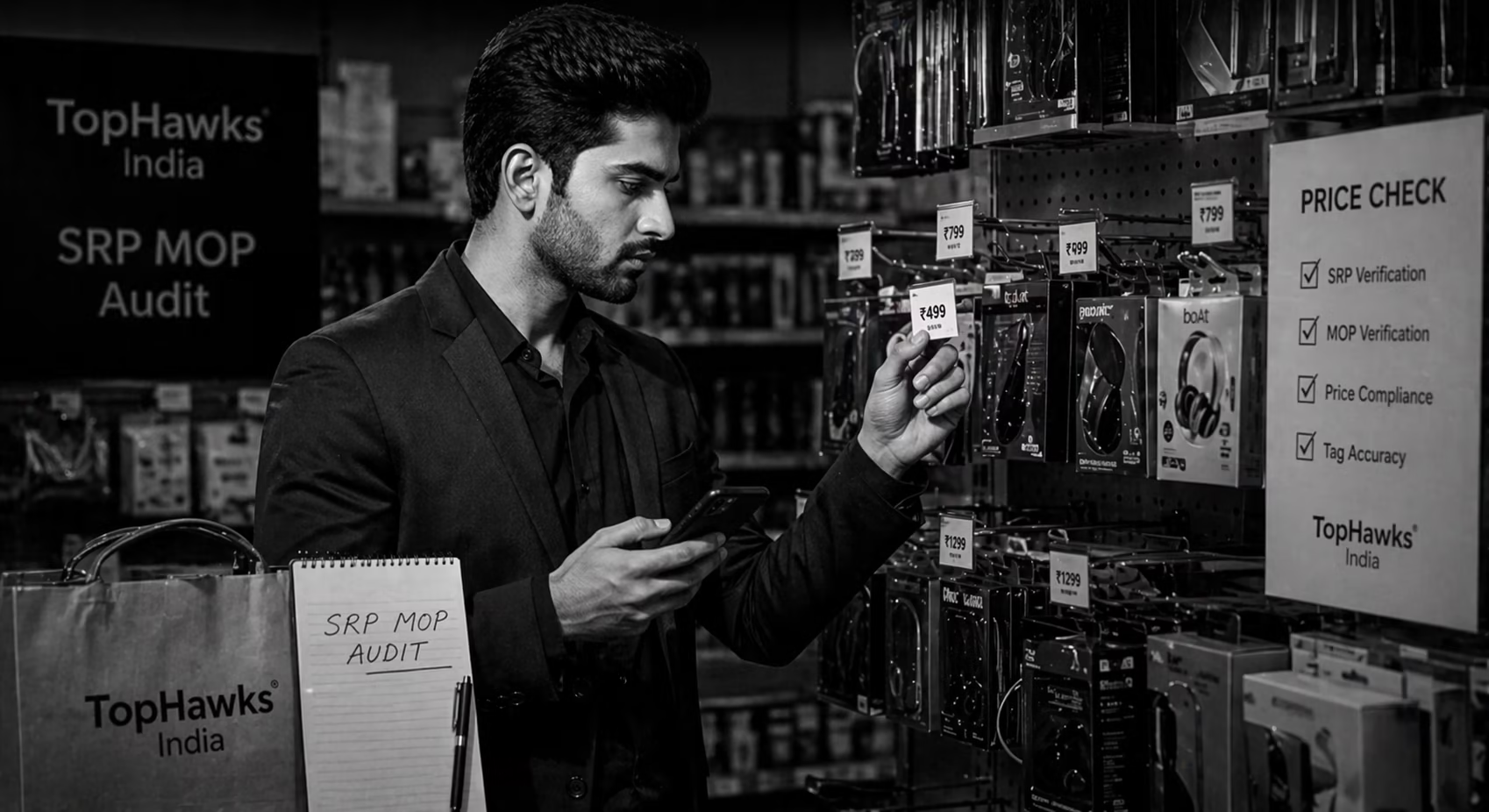
Are your retailers following brand pricing guidelines, and how do actual selling prices compare across outlets and competitors? TopHawks conducts retail price check audits, including Suggested Retail Price (SRP) audits and Market Operating Price (MOP) audits, to assess on-ground pricing behaviour. During these assignments, an auditor attempts to purchase a product at the best-negotiated price, capturing the actual offer made at the retail touchpoint.
Brands typically commission these audits for two reasons: to measure pricing variations and strengthen pricing discipline across the distribution channel, and to understand competitor pricing for commercial strategy. Structured observations help identify deviations from brand pricing guidelines, competitor schemes, promotional offers, and differences between communicated prices and actual market practices.
- Retail price compliance: Identify price violations against brand pricing guidelines across the channel.
- Competitor intelligence: Discover competitor pricing strategies, schemes, discounts, and offers available at retail outlets.
- Pricing discipline: Identify inconsistent selling practices that may contribute to customer dissatisfaction and price-hunting.
- Distribution economics: Provide evidence to support the preservation of financial interests across the distribution chain.
- Commercial decision-making: Generate market-level data for pricing strategy, scheme design, and offer optimisation.
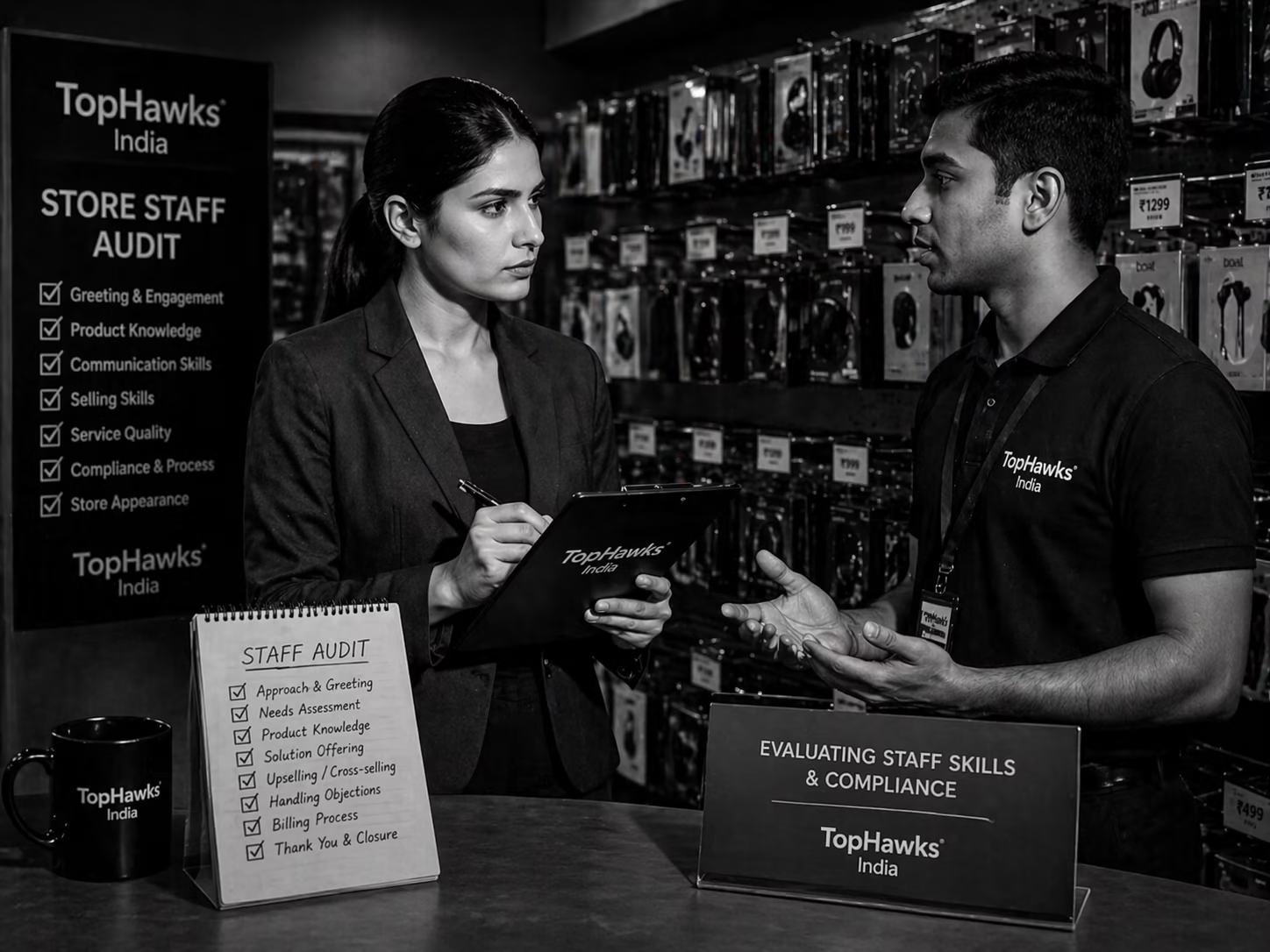
Your frontline employees shape how customers perceive your brand, understand your products, and make purchase decisions. The interaction with staff at a customer touchpoint is the most important factor in the overall customer experience. TopHawks conducts structured store staff mystery audits to evaluate employee behaviour, product knowledge, selling capability, and adherence to expected service standards during real customer interactions.
Our behaviour-based assessments identify specific training needs, measure training programme impact, and help determine whether the right people are deployed at the right locations. Rather than relying solely on general service ratings, these audits examine observable actions such as greeting customers, asking discovery questions, explaining product benefits, demonstrating products, addressing objections, and attempting to close a sale.
Learn how mystery shoppers are selected and what they evaluate in All You Need to Know About Our Mystery Shoppers.
- Professional presentation: Assess grooming, personal hygiene, communication skills, and customer-facing conduct.
- Product expertise: Evaluate product knowledge, demonstration skills, feature explanations, and upselling capability.
- Sales effectiveness: Review troubleshooting, negotiating, objection handling, and closing skills during customer interactions.
- Training effectiveness: Identify specific training gaps and measure the impact of training programmes through structured behavioural assessments.
- Workforce deployment: Determine whether appropriate staff profiles and capabilities are deployed at the right store locations.
What Does the Mystery Shopping Audit Method Achieve?
Effective mystery shopping goes beyond checking whether employees follow a script. It reveals what customers actually experience, where retail execution falls short, and which improvements deserve management attention. TopHawks designs structured mystery shopping and retail audit programmes around your customer experience, brand compliance, sales effectiveness, and operational performance objectives.
As an Indian field-execution agency, TopHawks combines trained auditors, structured assessment frameworks, and technology-enabled evidence collection to turn individual store visits into actionable insights. Our blog covers mystery audit steps and process in detail. Our approach connects audit findings with practical opportunities for service improvement, training, and retail execution.
- Identify customer delight drivers: Discover employee behaviours, service interactions, and customer engagement practices that create positive shopping experiences through structured mystery shopping programmes.
- Verify retail brand presentation: Conduct retail network audits to assess whether fixtures, furniture, signage, branded displays, and other customer-facing assets are properly maintained and compliant with brand standards.
- Improve inventory visibility: Use stock audit services to obtain accurate inventory measurements, support proper accounting, assess product freshness and quality, and identify opportunities to minimise shrinkage.
- Connect service quality with sales performance: Align company-wide customer service improvement efforts with measurable sales increases by identifying gaps in product recommendations, customer engagement, and conversion practices.
- Measure service consistency across locations: Determine whether customers receive consistently superior service at every location using standardised evaluation criteria and comparable store-level findings.
- Identify training and selling opportunities: Pinpoint frontline employee training gaps, evaluate suggestive selling behaviours, and identify opportunities to increase items per customer visit.
- Assess operational and regulatory compliance: Evaluate adherence to applicable legal requirements, internal procedures, and brand guidelines to help maintain a positive brand image.
Each programme can be configured around your store formats, priority locations, customer journeys, assessment criteria, and reporting requirements. The objective is to give regional managers, operations teams, and business leaders a consistent basis for identifying gaps and prioritising corrective action.
Start an Audit Programme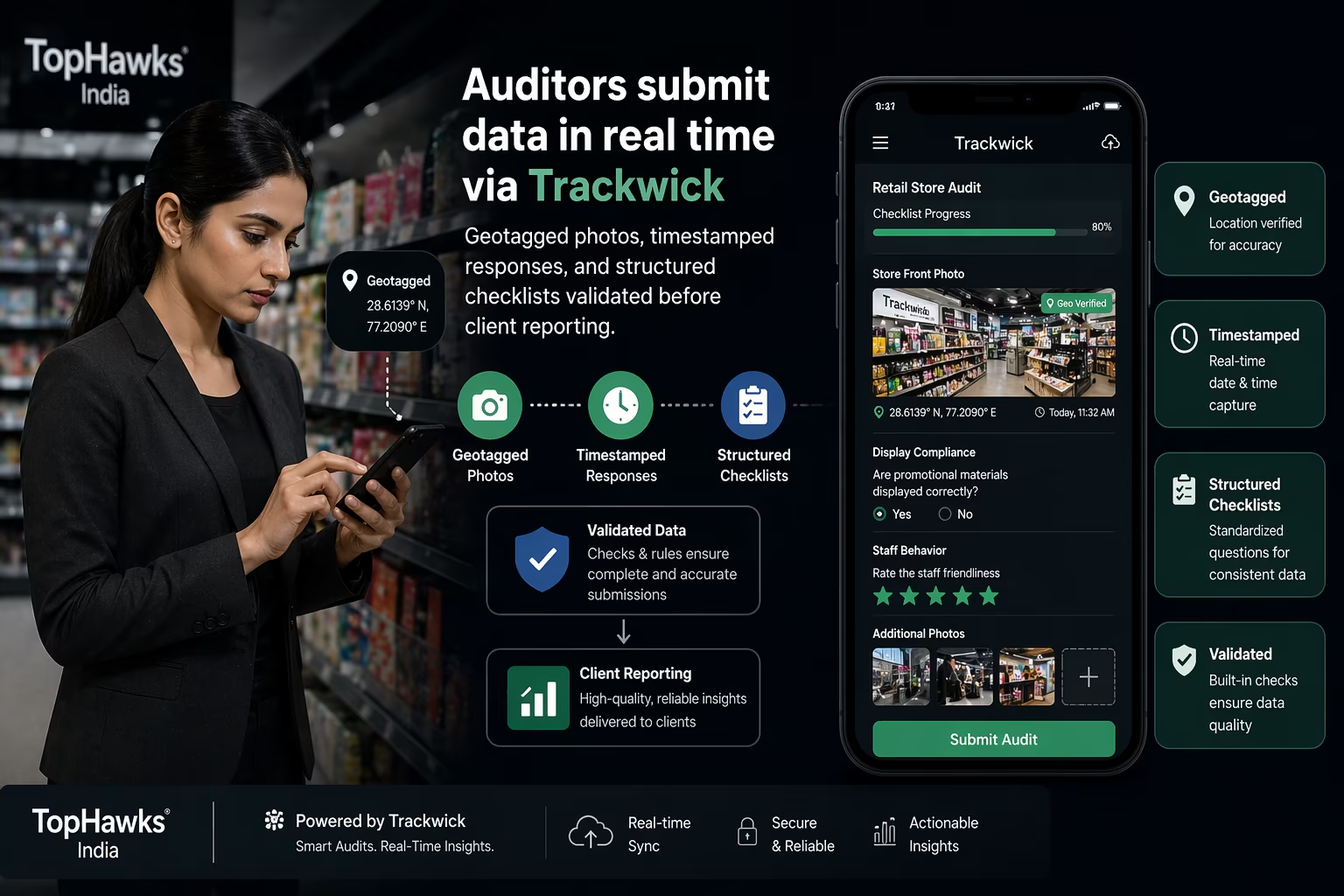
Ready to measure what's actually happening at your stores?
Book a 20-minute mystery shopping programme design call. We'll map audit types, locations, customer experience checkpoints, and key performance indicators (KPIs) — helping you define a practical, evidence-led audit brief.
Our Mystery Shopping Reporting Technology
TopHawks mystery shopping programmes use an in-house reporting app for data capture, geotagged photographic evidence and timestamps, with scoring and location-level reporting — configured to the objectives, checklists, and governance requirements of each programme.
This setup helps operations and customer experience teams move from individual field observations to structured, comparable audit intelligence. Geographic reporting, weighted assessment scores, and client-specific reporting makes it easier to identify compliance gaps, monitor execution consistency, and prioritise follow-up actions across retail networks.
Explore how TopHawks combines field execution, evidence collection, and quality validation in Our Approach to Mystery Shopping Execution.
Our Methodology →What Our Mystery Shopping Programmes Have Delivered
Explore two published TopHawks case studies featuring named clients, specific retail execution requirements, geographic coverage, and documented findings. These examples demonstrate how structured visibility audits, stock assessments, and technology-enabled field reporting support measurable improvements and operational decision-making.
Google Pixel — 35% Improvement in Retail Execution
TopHawks conducted systematic store-level visibility auditing for Google Pixel across India's modern trade retail network. The programme combined fixture compliance scoring, structured retail observations, and geotagged photo evidence to provide Google with a view of Pixel's retail brand health — producing a documented 35% improvement in retail execution.
The engagement demonstrates how evidence-backed visibility assessments can help brand and retail operations teams evaluate in-store presentation, compare execution standards across locations, and identify corrective priorities.
Eastman — Visibility and Stock Audits for Retail & Distribution Network
TopHawks supported Eastman's retail and distribution network through structured visibility audits and stock reconciliation. The assessment combined display compliance checks, stock accuracy verification, and category-level shrinkage monitoring to generate actionable supply chain insights.
By examining retail presentation alongside inventory records, the programme provided a structured basis for identifying merchandising discrepancies, understanding stock-related exceptions, and evaluating execution consistency across the distribution network.
Trusted by 800+ Brands Across India
From global multinationals to high-growth Indian consumer brands, TopHawks supports enterprise field-execution requirements across diverse industries. Our capabilities span mystery shopping, retail audits, sales outsourcing, staffing and on-ground brand execution. Every mystery shopping engagement is delivered to the same TopHawks quality standard, with structured field processes, documented evidence and actionable reporting.
The portfolio below represents brands associated with TopHawks' broader service offerings. Individual engagements may involve different field-execution services and should not be interpreted as mystery shopping assignments unless specifically identified.




How Does TopHawks Keep Mystery Shopping Data Accurate, Verifiable & Actionable?
Reliable mystery shopping depends on more than completing store visits. Decision-makers need confidence that observations are authentic, evidence is traceable and every reported finding can withstand operational scrutiny. TopHawks builds six quality-control safeguards into its mystery audit programme design before the first fieldwork wave begins.
Audit Questionnaire & Scorecard Design Before Fieldwork
A credible mystery shopping programme begins with a well-defined measurement framework. We develop the questionnaire or audit scorecard line by line with your team, translating service standards and operating procedures into specific, observable behaviours and photo-verifiable checks. Evaluation criteria, scoring rules and evidence requirements are established before a single mystery shopper is briefed.
Mystery Shopper Rotation & Evaluator Anonymity
A 1,50,000+ registered mystery shopper and auditor base supports evaluator selection and rotation across participating locations. Strict rotation rules are designed to prevent stores from encountering the same evaluator twice, reducing recognition risk and helping preserve the anonymity required for objective customer experience measurement.
Geolocation, Timestamp & Photographic Evidence Verification
Mystery shopping visits are supported by geotagged check-ins, time-stamped photographs and timestamped responses captured through TopHawks' in-house reporting application. This digital evidence trail supports verification of visit location, timing and submitted observations. Platform-level validation takes place before the information is incorporated into client-facing audit reports.
Independent Audit Back-Checks & Evidence Review
A separate quality assurance team independently re-verifies a percentage of completed mystery shopping visits during audit waves. This includes re-contacting locations where appropriate and re-scoring supporting evidence against the original submissions. The objective is to identify discrepancies, validate submitted observations and strengthen confidence in the final audit dataset.
Clear Submission Rejection Rules & Re-Fielding Accountability
Mystery audit submissions that fail evidence, timing or consistency checks are rejected and re-fielded. Defined acceptance and rejection criteria create accountability across the field-execution process. A vendor who rejects nothing is accepting everything; our approach prioritises verified audit quality over simply reporting completed visit counts.
Transparent Quality-Control Reporting With Every Delivery
Quality control (QC) is documented as part of the client deliverable, not retained solely as an internal operational record. Quality-control details are shared with the client, scoped per brief. This provides client teams with visibility into data validation, exceptions and corrective actions alongside the final store-level findings.
What this means for your business: Your mystery shopping findings are supported by documented audit criteria, geolocation and timestamp evidence, independent quality checks and transparent exception reporting. Whether you are evaluating retail customer experience, staff behaviour, pricing compliance or store operating standards, TopHawks provides an evidence-led framework designed to help your teams identify gaps, prioritise corrective action and monitor execution consistently.
Mystery Shopping vs Internal Audits vs Customer Feedback
Most brands already collect customer feedback, conduct internal store inspections or monitor satisfaction scores. However, these methods measure different aspects of retail performance. Mystery shopping evaluates what employees actually do during a customer interaction, internal audits examine operational compliance, and customer feedback reveals how shoppers perceive their experience.
For enterprise retail, banking, automotive, healthcare and service networks, the right approach is rarely to choose one method exclusively. A stronger customer experience measurement programme combines independent mystery shopping audits, operational inspections and customer sentiment to identify performance gaps, validate findings and prioritise corrective action.
| Evaluation Method | What It Measures Well | Limitations to Consider | Best Business Applications |
|---|---|---|---|
| Mystery shopping | Observed employee behaviour during an actual service interaction, assessed against a predefined scorecard by a trained, independent observer. Evaluates greeting standards, product knowledge, sales conversations and customer handling. | Covers a sample of visits rather than every customer interaction. Establishes what happened during the assessed visit, but does not always explain the underlying cause. | Standard Operating Procedure (SOP) compliance, selling behaviour, customer service standards, employee performance assessment and competitor comparison. |
| Internal audits by your own managers | Detailed operational assessments, direct visibility into store processes and faster corrective action, generally at a low direct cost. | Managers may audit their own areas, visits may be known in advance, and familiarity with local teams can influence assessment consistency or create a bias toward comfortable results. | Routine operational checks, supervisory reviews and ongoing compliance monitoring between independent audits. |
| Customer feedback and NPS | Customer satisfaction, perceived service quality, sentiment and changes in Net Promoter Score (NPS) over time. | Captures only customers who respond. Opinions do not directly establish observed employee behaviour, and differences in response patterns can make fair outlet comparisons difficult. | Tracking customer satisfaction trends, identifying recurring complaints and selecting service issues for deeper investigation. |
| Retail execution audits | Verifies whether store fixtures, inventory availability, pricing, promotional material and product visibility match agreed execution standards. | Measures physical retail execution but does not capture the quality of the customer service interaction. | Planogram compliance, signage verification, pricing accuracy, merchandising execution and on-shelf availability. |
Recommended approach: Use customer feedback and NPS trends to identify outlets that may be underperforming. Deploy mystery shoppers to establish how employees actually behave during service interactions. Complement these findings with retail execution audits to verify whether the physical store environment, pricing and merchandising meet brand standards.
Together, these methods give leadership teams a more complete view of customer experience, frontline execution and operational compliance—without treating any single measurement as the whole picture.
How to Design a Mystery Shopping Programme That Produces Reliable, Actionable Data
An effective mystery shopping programme begins long before the first store visit. The quality of its findings depends on clear evaluation criteria, realistic customer scenarios, consistent sampling and defensible scoring rules.
Whether you are assessing retail outlets, bank branches, automotive dealerships or customer service centres, these four programme design decisions determine how confidently management can compare locations, identify service gaps and initiate improvements.
1. Define an Objective Audit Scorecard
- Measure observable employee behaviour rather than subjective impressions: greeting, product questions answered, offer made, close attempted, billing and farewell.
- Weight individual evaluation parameters according to their relationship with revenue, customer experience or established brand standards.
- Keep questionnaires concise enough for mystery shoppers to accurately recall and document the interaction.
- Define clear scoring criteria so different shoppers assess the same behaviour consistently across outlets.
2. Develop Realistic Customer Scenarios
- Assign each mystery shopper a believable customer profile, purchase requirement and reason for visiting.
- Vary scenarios across visits to reduce predictable patterns that employees might recognise.
- Brief shoppers on the questions to ask, the appropriate stage of the interaction and information that must never be disclosed.
- Align each scenario with the service journey and sales behaviours the brand needs to evaluate.
3. Establish Sample Size and Audit Frequency
- Plan enough visits per outlet to distinguish recurring performance patterns from isolated incidents.
- Maintain comparable visit windows across locations so outlet-level scores can be interpreted fairly.
- Rotate audit days and times, including peak and quiet operating periods.
- Set the audit frequency according to business priorities, outlet performance and the need to measure improvement over time.
4. Protect Scoring Fairness and Confidentiality
- Communicate evaluation standards to store teams in advance without revealing individual mystery shopping visit schedules.
- Use findings primarily for employee coaching, then recognition and rewards, with penalties considered last.
- Establish a transparent process through which outlet managers can query or challenge individual scores.
- Review disputed findings against available supporting evidence before making performance decisions.
Enterprise implementation principle: Agree on the scorecard, shopper scenarios, outlet coverage and escalation rules before deployment. A consistent measurement framework makes mystery audit findings more useful for regional managers, customer experience teams and national leadership.
How Does TopHawks Keep Mystery Shopping Audit Data Reliable?
A completed questionnaire is not automatically a trustworthy audit. Field programmes must account for risks such as visits that never occurred, copied observations, photographs from the wrong outlet and inconsistent reporting.
TopHawks addresses these risks through technology-enabled evidence capture, submission validation, direct field management and re-audit procedures. Its in-house reporting app supports visit documentation with photos, geolocation and timestamps, helping connect reported findings to field activity.
1. Capture Evidence at the Source
- Mystery shopping visits are captured on TopHawks' in-house reporting app with geotagged photo evidence.
- Timestamps and location information are recorded as the visit happens.
- Evidence-linked submissions help reviewers assess whether reported observations correspond to the assigned outlet and visit.
2. Validate Submissions Before Client Reporting
- Mystery audit submissions are reviewed and validated before findings are included in client reports.
- Anomalies such as repeated photographs, inconsistent observations or implausible visit timing are queried with the shopper.
- Reviewing exceptions before reporting helps reduce the risk of unsupported findings influencing management decisions.
3. Maintain Direct Programme Accountability
- Audit scheduling and mystery shopper communication are managed through TopHawks, giving clients one accountable execution partner for programme quality.
- Shopper performance is tracked, and shopper performance is reviewed.
- Centralised coordination supports consistent instructions, escalation handling and field execution across locations.
4. Re-Audit Disputed or Doubtful Findings
- Disputed scores or questionable observations can be independently re-checked through a repeat mystery shopping visit.
- Patterns identified during re-audits are incorporated into shopper training.
- Follow-up verification helps distinguish an isolated reporting issue from a recurring outlet-level performance gap.
What this means for enterprise buyers: Mystery shopping findings should be supported by a reviewable evidence trail, documented validation and a process for resolving exceptions. These controls make audit reports more defensible and useful for operational decision-making.
How to Measure Whether a Mystery Shopping Programme Delivers ROI
The return on investment (ROI) from mystery shopping depends on your industry, store economics, margins and how effectively managers act on audit findings. A credible business case should therefore use your own operational and financial data rather than an assumed industry-wide return figure.
For retail and service businesses, mystery shopping can help identify revenue-related behavioural gaps, such as missed add-on recommendations, inconsistent product demonstrations or incomplete sales conversations. The commercial opportunity comes from correcting those behaviours and measuring whether performance improves.
- Select a revenue-linked employee behaviour. Identify a measurable action that influences the customer journey. For example, how frequently sales associates offer an add-on product or complete the recommended close.
- Establish the baseline through the first audit wave. Measure the current frequency of that behaviour across outlets using a consistent mystery shopping scorecard.
- Estimate the commercial performance gap. Use the outlet footfall you already know, your conversion rate and average basket value alongside the difference between your best-performing and typical outlets. This provides a basis for estimating the potential revenue opportunity associated with improved execution.
- Compare the potential benefit with programme cost. Assess whether closing even part of the identified gap could cover the cost of mystery shopping audits, reporting and associated improvement activities.
- Re-measure employee behaviour after coaching. Conduct a second audit wave using comparable evaluation criteria to establish whether targeted behaviours improved and by how much.
Important distinction: A higher mystery shopping score demonstrates improvement in the measured behaviour; it does not, by itself, prove incremental revenue. Where possible, compare subsequent audit findings with outlet sales, conversion and average transaction value to evaluate whether operational improvements correspond with commercial performance.
Build the business case using your organisation's actual sales figures, margins and programme costs. Avoid relying on unverifiable industry averages or treating projected revenue opportunities as guaranteed returns.
Why Mystery Shopping Audits Matter as Retail Expands into Tier-2 and Tier-3 Cities
As organised retail networks, branded dealerships and customer service outlets expand beyond major metropolitan markets, maintaining consistent customer experience standards becomes more challenging. Central management teams have less direct visibility into frontline interactions, and service practices that are followed in flagship locations may not be replicated consistently in newly established outlets.
Independent mystery shopping provides a consistent method for evaluating geographically distributed outlets. By applying the same scorecard across locations, brands can assess whether employees follow prescribed sales processes, demonstrate adequate product knowledge and deliver the expected service experience—regardless of the outlet's city or market tier.
TopHawks has shoppers and auditors across 246+ cities in 27+ states, enabling mystery shopping programmes to cover metro and non-metro outlets through one coordinated execution framework. An established multi-city field network also reduces the need for brands to build travel-heavy internal audit teams for dispersed locations.
With common evaluation criteria and a consolidated reporting view, enterprise teams can compare performance across metro, Tier-2 and Tier-3 markets, identify location-specific compliance gaps and prioritise coaching where service standards require attention.
For expanding retail networks: The goal is not simply to audit more stores. It is to maintain comparable service measurement across established outlets, newly launched locations and geographically dispersed markets as the business scales.
What Reports and Insights Do You Receive From a Mystery Shopping Programme?
A mystery shopping report should do more than present an overall score. Enterprise decision-makers need to understand which service standards were missed, where performance gaps are concentrated and what corrective action should take priority.
Before selecting a mystery shopping agency, request a sample audit report and assess whether its findings are specific, evidence-supported and suitable for outlet, regional and national reviews. TopHawks uses its in-house reporting app to support field submissions with photographs, geolocation and timestamps.
1. Outlet-Level Mystery Shopping Scorecards
- Section-wise evaluation scores covering the assessed customer journey, with photographic or written evidence supporting individual findings.
- Comparison of individual outlet performance against the overall programme average.
- Visibility into the specific employee behaviours and service standards requiring improvement.
2. City, Regional and National Performance Summaries
- Aggregated mystery shopping scores and performance spread by city, region and outlet format.
- Identification of locations where prescribed standards are consistently weak versus occasionally missed.
- Comparative performance views that help regional and national managers identify recurring execution gaps.
3. Prioritised Corrective Actions and Follow-Up Audits
- A focused list of the behaviours showing the largest performance gaps and the outlets requiring coaching first.
- Follow-up mystery shopping waves to track changes in service delivery and employee behaviour.
- Action-oriented findings that managers can use to plan targeted training and operational improvements.
4. Employee Recognition and Performance Analysis Inputs
- Structured audit data that can inform employee incentive and recognition programmes when supported by clear, consistent and fair scoring rules.
- Exportable audit results for independent analysis within the client's own reporting processes.
- Comparable performance information that supports ongoing coaching discussions and frontline development.
The enterprise reporting test: Can a store manager identify what needs fixing, can a regional manager see which locations require attention, and can national leadership distinguish isolated incidents from recurring service problems?
A well-structured mystery shopping programme should make these decisions easier through evidence-backed outlet scorecards, consolidated performance comparisons and repeat measurements that show whether corrective actions are working.
Five Questions to Ask Before You Hire a Mystery Shopping Agency
Choosing a mystery shopping agency in India requires more than comparing quotations, shopper network sizes and sample dashboards. Enterprise buyers should evaluate field-team accountability, audit evidence, quality assurance and reporting transparency. These five questions help distinguish agencies with direct operational oversight from those that primarily resell fieldwork.
- How are mystery shoppers recruited, trained and managed? Ask how shoppers are screened, matched to assignments and briefed on evaluation scenarios. Confirm who schedules visits, monitors completion and remains accountable for field execution. A clearly defined management structure helps establish responsibility when visits are delayed, incomplete or disputed.
- What verifiable evidence accompanies each mystery shopping visit? Look for geolocation, timestamps, photographs or recordings where permitted and required, structured questionnaire responses, and a documented validation process. Ask whether the reporting platform connects each observation to the relevant location, visit and supporting evidence. TopHawks uses an in-house reporting app with photographs, geolocation and timestamps to support field-level traceability.
- How are disputed scores, incomplete audits and questionable findings handled? Request a clear explanation of the quality-control workflow, evidence review, escalation process and circumstances that trigger a re-audit. Establish who approves corrections and how the agency maintains consistency across different auditors and locations.
- Which cities can you cover and how is coverage maintained? Ask for a location-wise coverage plan, deployment responsibilities, contingency arrangements and expected execution timelines. Confirm which locations are served through directly managed shoppers and which, if any, require external execution partners. Geographic reach should be supported by a realistic operating model.
- Can you share a sample mystery shopping report and a reference from a comparable industry? Evaluate whether the report provides location-level findings, evidence-backed scores, recurring exceptions and actionable recommendations. Where client confidentiality permits, request a relevant reference or comparable programme example. Reluctance to demonstrate reporting quality or explain the execution methodology warrants further scrutiny.
Procurement takeaway: A dependable mystery shopping partner should be able to explain who conducts each visit, how evidence is verified, how exceptions are resolved and how management teams can use the findings. Request a sample questionnaire, evidence-validation workflow and reporting format before finalising the scope.
How to Choose the Right Mystery Shopping or Retail Audit Programme
The right mystery shopping or retail audit programme starts with a clearly defined business problem. Before selecting an audit methodology, identify what needs to be measured, which evidence will establish compliance or non-compliance, and who will be responsible for acting on the findings.
Different operational problems require different evaluation methods. A brand experiencing inconsistent customer interactions may need mystery shopping to assess employee behaviour, product explanations and service delivery. A brand facing inconsistent retail presentation may need a structured retail operations audit covering displays, signage, fixtures and store-level execution. Where pricing discipline is the concern, a price check audit should capture actual selling prices, applicable pricing guidelines and relevant promotional offers.
TopHawks provides mystery shopping, retail operations audits, stock audits, e-commerce seller audits, price check audits and store staff audits. Each programme addresses a distinct operational question. The questionnaire, evidence requirements, scoring methodology and reporting structure should therefore be designed around the intended business objective rather than adapted from a single generic checklist.
Use the comparison below to identify the most appropriate audit methodology for your business requirement.
| Business Objective | Recommended Audit Type | What to Evaluate |
|---|---|---|
|
Understand the actual customer experience Identify gaps between defined service standards and real customer interactions. | Mystery Shopping | Staff interaction, service quality, product knowledge, customer handling and billing accuracy. |
|
Check store standards and operating procedures Verify whether retail outlets follow defined brand and operational requirements. | Retail Operations Audits | Fixtures, signage, product displays, store presentation and standard operating procedure (SOP) compliance. |
|
Verify inventory conditions Identify discrepancies between expected inventory standards and observed stock conditions. | Stock Audits | Stock accuracy, product availability, freshness, inventory condition and indicators of potential shrinkage. |
|
Assess online seller compliance Check whether marketplace sellers follow agreed product-listing and commercial requirements. | E-Commerce Seller Audits | Marketplace listings, product information, seller practices and compliance against defined requirements. |
|
Identify pricing deviations Monitor actual market prices against applicable brand pricing policies. | Price Check Audits (SRP/MOP) | Actual selling prices, suggested retail price (SRP), market operating price (MOP), pricing guidelines and competitor offers. |
|
Identify staff training needs Assess frontline employee readiness and identify opportunities for targeted coaching. | Store Staff Audits | Grooming, communication, product knowledge, selling behaviour and adherence to defined service expectations. |
Should You Combine Multiple Audit Types in One Programme?
Yes, when the business requirement spans multiple areas of retail execution. For example, a programme may need to assess customer service, product availability, store presentation and pricing compliance across the same outlet network.
For programmes covering several business objectives, define the primary objective first and then add secondary evaluation criteria. Separate the relevant scoring dimensions so that a strong result in one area does not conceal a critical compliance failure in another. This keeps the scorecard focused, improves comparability and makes findings easier to interpret.
What Should the Final Mystery Shopping or Retail Audit Report Show?
Reporting requirements should reflect the decisions each stakeholder needs to make. A retail operations team may need individual store exceptions and photographic evidence. Regional managers may need comparisons across outlets, cities or teams. National leadership may need consolidated performance trends, recurring compliance gaps and priorities for corrective action.
TopHawks supports evidence-led reporting through its in-house reporting app, which captures photographs, geolocation and timestamps. These records help connect submitted observations to the relevant field visits and provide context for reviewing exceptions.
Before fieldwork begins, agree on the reporting hierarchy, key performance indicators (KPIs), scoring criteria, evidence requirements and escalation responsibilities. This ensures that the final mystery shopping report supports operational decisions rather than simply documenting completed visits.
How Does a Mystery Shopping Programme Work, From Brief to Corrective Action?
An enterprise mystery shopping programme follows a structured cycle of planning, field execution, evidence validation, reporting and performance improvement. The objective is not simply to complete store visits. It is to measure actual customer experiences against agreed standards, identify execution gaps and provide reliable evidence for corrective action.
TopHawks approaches mystery shopping as a field-execution and reporting process, combining shopper deployment with structured evaluations and its in-house reporting app for photographs, geolocation and timestamps.
Step 1: Define the Business Objective and Success Criteria
Begin by identifying the specific question the programme must answer. Examples include whether frontline employees explain products accurately, whether selling procedures are followed, whether customers receive the expected service experience, or whether defined brand standards are consistently maintained.
Establish measurable evaluation criteria and identify which findings require management intervention. A focused objective makes the questionnaire more relevant and reduces ambiguity during reporting.
Step 2: Select Locations, Customer Touchpoints and Audit Scope
Define the stores, cities, regions, channels or customer touchpoints to be covered. Determine whether the programme requires a representative sample, visits to every selected location, or repeated evaluations across different periods.
TopHawks has a network of 1,50,000+ mystery shoppers and auditors across 246+ cities, supporting programmes across a wide range of Indian markets.
The scope should specify location eligibility, expected visit frequency, geographic distribution, evaluation scenarios and any operational constraints that could affect field execution.
Step 3: Design the Mystery Shopping Questionnaire and Scoring Framework
Translate the agreed business objectives into specific, observable checks. Define the expected behaviour or operating standard, the response options available to auditors, the evidence required and the contribution of each scored question to the final result.
Distinguish between objective observations, such as whether a product demonstration occurred, and subjective assessments, such as the perceived quality of an interaction. Where applicable, define question weightings, critical compliance failures and rules for responses that are not applicable.
A well-designed scorecard makes findings more consistent across auditors, stores and subsequent audit waves.
Step 4: Recruit, Brief and Prepare the Field Team
Select suitable mystery shoppers or auditors according to the assignment requirements, target customer profile, geography and evaluation scenario.
Communicate the visit scenario, expected customer journey, questionnaire instructions, evidence requirements, submission process and applicable conduct guidelines. Where necessary, clarify how shoppers should handle unavailable products, closed outlets, interrupted visits or situations that do not match the planned scenario.
Consistent briefing helps reduce interpretation differences and improves the comparability of findings across the field network.
Step 5: Execute Mystery Shopping Visits and Capture Field Evidence
Shoppers conduct the assigned visits and document their observations against the approved questionnaire. Depending on the programme, evidence may include timestamps, geotagged photographs, permitted recordings and other relevant observations.
TopHawks uses an in-house reporting app with photographs, geolocation and timestamps to support traceability of field submissions.
Evidence requirements should be established before deployment, with recording or photography conducted only where permitted and appropriate. Every submission should be sufficiently complete to support the corresponding evaluation.
Step 6: Validate Submissions and Resolve Audit Exceptions
Review completed submissions for accuracy, completeness, consistency and alignment with the programme requirements.
Validation may involve checking location evidence, timestamps, questionnaire responses, supporting photographs and inconsistencies between recorded observations and assigned scores. Flag incomplete or questionable findings for clarification and determine whether a correction, further review or re-audit is required.
The objective is to ensure that management decisions are based on defensible observations rather than unverified field submissions.
Step 7: Report Findings and Assign Corrective Action
Present audit results at the individual location level and aggregate them according to the relevant business hierarchy, such as city, region, channel or operational team.
The report should distinguish isolated exceptions from recurring operational weaknesses. Where supported by the evidence, identify patterns in customer service, product knowledge, pricing compliance, retail presentation or adherence to operating procedures.
Translate findings into a corrective-action plan with clearly assigned responsibilities, priority levels and review expectations. A regional manager may need to resolve store-specific issues, while central teams may need to address recurring training or process gaps.
Step 8: Conduct Follow-Up Audits and Measure Progress
Repeat the relevant evaluation criteria after corrective actions have been implemented. Compare the follow-up findings with the original baseline using consistent scoring definitions, comparable locations and appropriately matched audit conditions.
Assess whether the observed execution has improved, remained unchanged or requires further investigation. Where recurring gaps persist, revisit the underlying process, training requirement or operational control before planning the next evaluation cycle.
What Makes a Mystery Shopping Programme Effective Over Time?
Continuity is the defining principle: establish the standard, measure real-world execution, validate the evidence, assign corrective action and measure again.
A one-time mystery shopping study can reveal the current customer experience. A recurring, consistently measured programme can also help management understand performance patterns, assess corrective actions and identify issues requiring further attention.
For organisations planning a multi-location mystery shopping or retail audit programme in India, TopHawks can help define the audit scope, evaluation criteria, field requirements and reporting structure around the specific operational questions the business needs to answer.
Mystery Shopping KPIs: What Should You Measure and How Should You Act on the Results?
A mystery shopping report delivers business value when it connects independently observed customer experiences, employee behaviours and operational conditions to measurable performance standards. The right key performance indicators (KPIs) depend on your audit objectives, store format, customer journey and the corrective actions your organisation can implement.
For enterprise retail networks, a single overall audit score rarely tells the complete story. A store may achieve an acceptable aggregate rating while failing a critical service, pricing or compliance requirement. Effective mystery shopping analytics should therefore distinguish overall performance from individual service behaviours, standard operating procedure (SOP) compliance and operational exceptions.
The following mystery shopping KPI framework helps retail operations, customer experience, sales excellence and compliance teams define measurable audit criteria, interpret findings and prioritise improvements.
| KPI or measure | What it tells you | How to use it |
|---|---|---|
| Overall audit score | How a location performs against the defined mystery shopping scorecard and evaluation standards. | Compare locations using consistent criteria and identify performance outliers requiring further investigation. |
| Section-level score | Which stage of the customer journey or operational process is underperforming. | Identify specific service, sales or operational stages requiring targeted intervention. |
| SOP compliance | Whether employees and locations follow required standard operating procedures. | Prioritise corrective actions for missed operational, service and compliance standards. |
| Product knowledge score | Whether frontline employees communicate accurate, relevant and expected product information. | Identify product knowledge gaps and define focused employee training requirements. |
| Selling behaviour compliance | Whether employees demonstrate the required consultative selling and customer engagement practices. | Focus sales coaching on missed recommendations, product demonstrations, objection handling or closing steps. |
| Pricing compliance | Whether observed product prices meet applicable pricing policies and programme requirements. | Investigate pricing deviations and coordinate corrective action with relevant sales or channel partners. |
| Retail visibility compliance | Whether required product displays, promotional signage and retail fixtures are present and correctly maintained. | Prioritise store-level visual merchandising corrections and verify the implementation of display standards. |
| Stock accuracy | Whether recorded and observed inventory information aligns, according to the agreed audit method. | Investigate inventory discrepancies, stock availability concerns and potential stock-control issues. |
| Evidence completeness | Whether all mandatory questionnaire responses and supporting audit evidence have been submitted. | Assess submission reliability, identify missing documentation and flag records requiring quality review. |
| Repeat audit score | Whether measured performance changes after corrective action or employee intervention. | Evaluate improvement against the original audit baseline using comparable evaluation criteria. |
How Do You Turn Mystery Shopping KPIs into Operational Decisions?
Effective mystery shopping performance management follows a structured cycle: establish a baseline, identify critical gaps, assign corrective actions and verify whether the intervention has addressed the observed issue.
- Establish a reliable performance baseline. Use the initial mystery shopping audit wave to document current performance across the agreed locations, customer journey stages and evaluation criteria. Ensure that scoring definitions are consistent before comparing stores or regions.
- Prioritise findings according to business impact. Review critical service failures, missed SOP requirements, pricing deviations and other material exceptions alongside overall scores. A high-scoring location may still require urgent attention if it fails an essential operating standard.
- Assign accountable owners and corrective actions. Direct product knowledge gaps to the relevant training team, selling behaviour issues to sales managers and pricing deviations to sales or channel management. Define the expected correction and responsibility for follow-up.
- Verify improvements through repeat mystery audits. Reassess the relevant requirements after the intervention. Apply the same evaluation criteria so that changes can be compared meaningfully against the original baseline.
- Review unresolved and recurring exceptions. Distinguish between corrected findings, persistent failures and issues that require a different intervention. Use this analysis to determine where management attention and additional resources are needed.
Evidence matters as much as the score. TopHawks supports its field-execution programmes through an in-house reporting app that captures photographs, geolocation and timestamps. These records help connect submitted observations with the corresponding field visit and provide supporting information for quality review, subject to the agreed audit methodology.
The management takeaway: A successful mystery shopping programme should do more than rank outlets. It should identify the specific standards being missed, provide evidence for the findings, establish accountability and make subsequent improvements measurable. This turns mystery shopping from a periodic assessment into a practical input for customer experience improvement, frontline coaching and retail operational governance.
How to Compare Mystery Shopping Companies in India Before Selecting a Vendor
Choosing a mystery shopping agency in India requires more than comparing commercial quotations, shopper network sizes or geographic coverage. Two service providers may propose similar audit volumes while using very different approaches to questionnaire design, shopper preparation, field supervision, evidence validation and management reporting.
For enterprise brands managing multiple stores, dealerships, branches or customer-facing locations, these operational differences directly affect whether the findings are consistent, credible and actionable.
A structured mystery shopping vendor evaluation should therefore examine the provider's ability to translate your business standards into observable criteria, coordinate field execution, validate submissions and deliver reporting that supports operational decisions.
Use the following checklist when evaluating mystery shopping service providers, reviewing proposals or conducting vendor capability discussions.
| Evaluation criterion | Questions to ask | What a strong answer should explain |
|---|---|---|
| Geographic coverage | Which cities, towns, outlets and remote locations can you serve for our specific programme? | How the required locations will be covered, assignments allocated and field execution coordinated across the proposed geography. |
| Field workforce | Who recruits, screens, selects and coordinates the mystery shoppers or auditors? | Who is accountable for shopper suitability, assignment communication, field coordination and visit completion. |
| Questionnaire design | How will the mystery audit scorecard reflect our customer experience standards and operating procedures? | How business objectives and operational requirements become clearly defined, observable and consistently scored evaluation criteria. |
| Shopper preparation | How will field shoppers understand the assigned customer scenario, questionnaire and evidence requirements? | How assignment-specific briefings, scenario preparation and reporting instructions are communicated before fieldwork. |
| Evidence collection | What evidence will support each mystery shopping visit and its reported observations? | Which questionnaire responses, photographs, timestamps, geolocation records or other supporting documents are required under the agreed audit protocol. |
| Quality assurance | How are incomplete, inconsistent or questionable audit submissions identified and handled? | How submission checks, clarification requests, corrections, evidence validation and rejection decisions are managed. |
| Reporting | What will the final mystery shopping report show, and how will our managers access the findings? | How performance, compliance gaps and supporting evidence are presented by outlet, location, region and evaluation category. |
| Corrective action | Can critical findings be reassessed after training, process changes or other corrective interventions? | How repeat mystery shopping audits can measure changes against the original baseline using comparable scoring criteria. |
| Accountability | Who will manage operational escalations, reporting queries and execution issues during the programme? | The defined responsibilities of the client team, service provider, field coordinators and relevant escalation contacts. |
Why Should You Request a Sample Mystery Shopping Report Before Appointing an Agency?
A sample mystery shopping report is one of the most useful documents in a vendor evaluation. It allows procurement, customer experience and retail operations teams to assess the practical usefulness of a provider's reporting rather than relying solely on proposal descriptions.
Review whether a manager can easily identify:
- The audited location: Which store, branch, dealership or customer touchpoint was assessed.
- The evaluation requirement: Which operating standard or customer experience expectation was met or missed.
- The supporting evidence: What recorded observation, photograph, timestamp or other agreed evidence supports the finding.
- The performance gap: Why the observed result differs from the expected operating standard.
- The recommended next step: Which operational issue should be investigated, corrected or monitored.
Also examine whether the scoring methodology supports fair comparisons between different locations. If the provider uses weighted audit scores, ask how those weights are determined, whether critical failures are treated separately and whether managers can review the underlying criteria instead of relying exclusively on an aggregated result.
Procurement consideration: A visually polished dashboard is not, by itself, evidence of reporting quality. The underlying observations, definitions, validation process and ability to trace findings back to individual visits determine whether the report can support confident management decisions.
What Should Be Agreed Before Mystery Shopping Fieldwork Begins?
Before issuing the final work order or authorising field deployment, document the audit scope, responsibilities and reporting expectations in writing. This reduces uncertainty during execution and provides a common reference for resolving operational questions.
The agreed scope should clearly specify:
- Audit coverage: The locations, outlet categories and visit requirements included in the programme.
- Evaluation methodology: The approved questionnaire, customer scenarios, scoring rules and applicable operating standards.
- Evidence requirements: The photographs, geolocation information, timestamps and other supporting records required for each assignment, where applicable.
- Quality validation: The process for reviewing incomplete submissions, raising clarification requests and handling records that fail agreed acceptance criteria.
- Reporting deliverables: The expected report structure, location-level observations, management summaries and agreed reporting format.
- Operational accountability: The responsible stakeholders, communication process and escalation procedure for execution or reporting issues.
- Follow-up evaluation: Whether repeat audits are required to assess corrective actions against the initial performance baseline.
Why Consider TopHawks for Enterprise Mystery Shopping Programmes in India?
TopHawks has operated since 2015 and serves 800+ brands. Its network includes 1,50,000+ mystery shoppers and auditors across 246+ cities. These established capabilities provide a starting point for evaluating field coverage and programme coordination requirements across India.
As a field-execution agency, TopHawks approaches mystery shopping through structured audit requirements, field coordination and evidence-supported reporting. Its in-house reporting app supports the collection of photographs, geolocation and timestamps, helping associate field submissions with their recorded visit details for subsequent review.
However, network scale alone should never be treated as a guarantee of successful execution. Every programme should be evaluated against its actual geography, store formats, shopper profiles, audit complexity, evidence requirements and reporting expectations.
When discussing a potential engagement with TopHawks, share your proposed outlet list, audit objectives, customer interaction scenarios, expected deliverables and quality requirements. These details provide the basis for assessing execution suitability and defining a programme scope aligned with your operational priorities.
The selection principle: The best mystery shopping vendor is the one whose execution model, quality assurance procedures, evidence standards and reporting capabilities match your business objectives. A well-designed programme should help your teams understand what happened at the customer touchpoint, why the finding matters and what should happen next.
Mystery Shopping Services in India — Frequently Asked Questions
Get practical answers to the questions brand managers, retail operations heads, customer experience leaders and procurement teams ask when evaluating mystery shopping agencies in India. Explore audit coverage, quality assurance, reporting technology, deployment timelines, programme design and corrective action. For a comprehensive introduction, read Unveiling the Secrets of Mystery Shopping: Everything You Need to Know.
Mystery shopping is a structured, independent evaluation of the customer experience and operational standards at a business location. Trained auditors visit stores, restaurants or service centres while presenting themselves as regular customers. They observe actual customer-facing interactions and assess performance against predefined evaluation criteria.
A typical mystery shopping programme covers:
- Programme design: Define business objectives, evaluation parameters, scoring methodology and reporting requirements.
- Auditor deployment: Select and brief auditors who match the required customer profile.
- Field evaluation: Assess staff behaviour, product knowledge, customer engagement, pricing and standard operating procedure (SOP) compliance.
- Evidence collection: Capture structured questionnaire responses and supporting evidence through the in-house reporting application.
- Quality assurance: Validate submissions and review inconsistencies before accepting findings.
- Management reporting: Apply weighted-index scoring and present actionable findings at the individual location, regional and national levels.
The objective is to identify what customers actually experience, where operational standards are being missed and which corrective actions management should prioritise.
TopHawks conducts mystery audits across 246+ cities and towns, covering Tier-1 metropolitan markets, Tier-2 cities and remote rural locations.
Its network of 1,50,000+ shoppers and auditors supports multi-location mystery shopping programmes with coverage confirmed per brief.
For national retail chains, consumer brands and distributed service networks, this enables a coordinated audit programme with consistent evaluation criteria, centralised reporting and location-level performance visibility.
The Google Pixel case study documents this engagement in detail.
Coverage for a specific assignment is planned against the required outlet list, geographic distribution, audit methodology and deployment schedule.
TopHawks offers five core audit types, each designed to address a distinct customer experience, retail execution or compliance objective.
- Mystery Shopping — Customer Experience Measurement: Evaluate staff greetings, customer engagement, needs assessment, product knowledge, sales conversations, complaint handling and overall service delivery.
- Retail Operations Audits — Fixture, Signage and SOP Compliance: Verify merchandising standards, display execution, fixture conditions, promotional visibility, store readiness and adherence to prescribed operating procedures.
- Stock Audits — Inventory Accuracy and Shrinkage: Examine physical inventory, stock availability, inventory-record discrepancies and potential shrinkage indicators.
- E-commerce Seller Audits — Marketplace Compliance: Assess seller-level adherence to defined marketplace requirements, including relevant product listings, presentation standards and compliance parameters.
- Price Check Audits (SRP/MOP) — Pricing Discipline and Competitor Intelligence: Verify applicable suggested retail price (SRP) and market operating price (MOP) requirements, identify pricing deviations and collect defined competitor pricing observations.
These audit types can be implemented individually or combined into a coordinated programme when a brand needs to assess customer experience, pricing, stock availability and retail execution together.
Further reading: Mystery Shopping — A New Approach.
TopHawks supports mystery audit quality through layered verification spanning auditor selection, preparation, field supervision, technology-based checks and supporting evidence.
- Customer-profile matching: Auditors are selected to match the customer profile required for the assignment.
- Programme-specific preparation: Auditors complete training, testing and certification against the programme's approved evaluation methodology.
- Dedicated operational review: TopHawks schedulers and editors review submissions.
- Automated platform validation: The in-house reporting app supports structured response capture and automated checks against defined submission requirements.
- Visit evidence verification: Geotagged, timestamped photographs are used to support visit verification.
Only submissions clearing all five quality layers are presented to clients.
This verification framework helps brand teams distinguish substantiated operational findings from incomplete, inconsistent or unsupported observations.
TopHawks uses an in-house reporting app for mystery shopping field-data capture and reporting. It supports the operational workflow from audit scheduling and field-data capture through response validation, weighted-index scoring and management reporting.
Core capabilities include:
- Audit scheduling: Coordinate planned visits across assigned outlets and geographies.
- Structured field submissions: Collect questionnaire responses through the in-house reporting application.
- Visit evidence: Capture Global Positioning System (GPS) location information, geotagged photographs and timestamps.
- Response validation: Check submitted observations against the programme's defined data-quality requirements.
- Weighted-index scoring: Calculate performance scores using the agreed evaluation framework.
- Location-level reporting: Identify strengths, failures and improvement opportunities for individual outlets.
- Regional and national dashboards: Review regional aggregations, national benchmarks and performance patterns through customisable dashboards.
The platform was used in the Google Pixel programme.
For enterprise teams, the reporting objective is to connect verified field observations with decisions about store performance, operational compliance, employee coaching and corrective action.
Mystery shopping programme launch timelines depend on the geographic coverage, number of locations and complexity of the evaluation.
The launch process includes:
- Questionnaire design: Finalise audit objectives, assessment criteria and scoring rules.
- Auditor selection: Match available auditors to the required markets and customer demographics.
- Reporting configuration: Set up questionnaires, field reporting and validation requirements.
- Auditor briefing: Communicate visit scenarios, documentation standards and programme-specific instructions.
- Field deployment: Begin visits according to the approved coverage and execution schedule.
First-wave timing is agreed per brief. Actual scheduling depends on audit complexity, location accessibility, questionnaire approval and programme scale.
For urgent pilot programmes, phased rollouts or time-sensitive retail compliance checks, contact mysteryshopping@tophawks.com with your required locations, audit objectives and target dates.
Learn more about the execution framework: Our Approach.
Mystery shopping frequency should reflect operational risk, business objectives, customer interaction volume and the speed at which management can implement corrective action.
An effective programme generally begins with a baseline audit wave to establish current performance. Subsequent audits can evaluate whether coaching, operational improvements or corrective actions have addressed identified gaps.
Brands should consider the following factors when setting audit frequency:
- Compliance sensitivity: Critical pricing, safety or operating-standard checks may require closer monitoring.
- Performance variation: Locations with recurring deviations may need more frequent follow-up.
- Operational changes: New product launches, revised sales processes and employee training initiatives may justify additional audit waves.
- Management capacity: Audit frequency should allow sufficient time to investigate findings and complete corrective actions.
- Comparability: Repeat evaluations should use consistent criteria wherever possible so that performance changes can be interpreted reliably.
The objective is not simply to increase audit volume. It is to establish a measurement cycle that produces actionable findings and verifies whether required improvements are sustained.
Yes. Mystery shopping questionnaires can be customised to reflect the customer journey, operating procedures and compliance requirements of different retail and service formats.
For example, a brand may use common criteria to evaluate staff greetings, customer engagement and service professionalism across its network, while introducing additional checks for:
- Experience-led stores: Product demonstrations, feature explanations and assisted selling.
- Large-format retail: Department navigation, product availability and service-point interactions.
- Quick-service restaurants: Ordering interactions, service procedures, hygiene observations and billing.
- Service centres: Complaint registration, service explanations, turnaround communication and customer handling.
- Different store categories: Format-specific facilities, merchandising requirements and selling procedures.
To preserve reporting consistency, the programme should separate common performance indicators from format-specific evaluation criteria.
All differences should be defined before fieldwork so that results are evaluated against the correct operating standards and comparisons remain meaningful.
Mystery shopping reports help training and operations teams identify specific observable behaviours that require improvement, rather than relying exclusively on an overall customer service score.
A structured audit can establish whether employees consistently:
- Greet and acknowledge customers according to the expected service standards.
- Ask relevant questions to understand customer requirements.
- Explain product features, benefits and pricing accurately.
- Conduct demonstrations and follow the prescribed selling process.
- Respond appropriately to objections, questions and service concerns.
- Follow billing, checkout and other defined operational procedures.
Managers can review findings at the employee, outlet or regional level where the audit methodology supports that analysis, then identify recurring capability gaps.
Training teams can translate these findings into targeted coaching, refresher sessions and process reinforcement. Follow-up mystery shopping audits can then assess whether the required behaviours are being demonstrated consistently.
This establishes a practical measure, coach, verify and improve cycle connecting mystery shopping findings with workforce development and retail execution.
A serious mystery audit finding should trigger a documented verification, escalation and corrective-action process proportionate to the nature of the risk.
- Verify the evidence: Review the submitted observations, photographs, timestamps and other available records against the agreed evaluation criteria.
- Classify the issue: Determine the operational importance, potential customer impact and applicable compliance implications.
- Assign accountability: Route the finding to the relevant store, regional, compliance or central operations team.
- Document corrective action: Record the required resolution, responsible owner and expected completion timeline.
- Verify closure: Review supporting resolution evidence and determine whether a repeat mystery audit is necessary.
Critical findings should follow the brand's established escalation procedures immediately rather than remain unresolved until the next scheduled reporting cycle.
A mystery shopping report identifies and documents observed deviations. Management remains responsible for investigating findings, determining appropriate action and confirming operational closure.
Fair mystery shopping benchmarking requires consistent evaluation criteria, predefined scoring rules and transparent treatment of differences between store formats and operating conditions.
For reliable cross-location comparisons, brands should:
- Standardise core questions: Apply identical definitions to customer-facing behaviours and operating standards expected across all locations.
- Agree on scoring rules: Establish weightages, response options and evaluation thresholds before fieldwork.
- Document format differences: Separate criteria that apply only to specific store categories or customer journeys.
- Maintain audit consistency: Use common auditor instructions, evidence requirements and submission-validation procedures.
- Compare relevant peer groups: Interpret results within comparable outlet formats and operating contexts.
- Examine granular findings: Review individual outlet scores alongside city, regional and national aggregates.
Regional averages can conceal significant location-level problems. Management teams should therefore examine both aggregated performance and the underlying observations supporting each score.
Reporting supports location-level scores, regional aggregations and national benchmarks, helping stakeholders examine performance across different levels of the retail network.
A clear mystery shopping brief enables the agency to recommend an appropriate audit methodology, deployment plan, reporting structure and commercial proposal.
Before requesting a quotation, prepare the following:
- Business objectives: Explain whether the programme will evaluate customer experience, sales effectiveness, pricing compliance, retail operations or another defined requirement.
- Outlet universe: Share the store or service-location list, including cities, towns and applicable store formats.
- Audit scope: Specify the required mystery shopping, stock, pricing, retail operations or other audit categories.
- Evaluation criteria: Provide existing service standards, operating procedures, questionnaires or compliance checklists where available.
- Customer scenarios: Describe any required purchase journeys, product enquiries, service interactions or demographic requirements.
- Evidence requirements: Identify required photographs, location verification, timestamps and other permitted supporting records.
- Deployment expectations: Indicate preferred launch dates, audit waves, coverage priorities and reporting deadlines.
- Reporting needs: Define outlet-level visibility, management dashboards, scorecards, regional comparisons and required data outputs.
- Internal stakeholders: Identify the teams responsible for reviewing findings, managing escalations and implementing corrective actions.
Most importantly, explain which business decisions the audit results must support. This helps align the questionnaire, scoring methodology and reporting outputs with actionable management priorities.
Whether the requirement is a focused pilot, a recurring retail compliance programme or a geographically distributed mystery shopping initiative, TopHawks can use this information to structure an execution proposal around the brand's stated objectives.
Expert Insights on Mystery Shopping & Retail Audits
Explore practical guides, industry perspectives and expert articles from the TopHawks team. Learn how mystery shopping programmes, structured retail audits and evidence-based reporting help brand managers, customer experience leaders and retail operations teams evaluate service standards, identify execution gaps and prioritise corrective action.
Related TopHawks Retail Execution Services
Mystery shopping identifies what customers experience and where retail execution falls short. TopHawks complements these insights with visual merchandising, sales outsourcing and staffing services to help brands address identified gaps, strengthen store-level compliance and improve frontline execution.
Join a network of 1,50,000+ shoppers — explore flexible, paid mystery shopping and retail audit assignments across your city.
Plan Your Mystery Shopping Programme with TopHawks
Need an experienced mystery shopping agency for a pilot, multi-location retail audit or pan-India customer experience evaluation? Share your industry, store locations, audit objectives and expected scope. Our mystery shopping specialist will help you evaluate the right audit approach, reporting requirements and deployment plan. Share your brief and our team will follow up.
TopHawks combines on-ground audit execution with an in-house reporting app that captures photographic evidence, geolocation and timestamps, giving your team structured, verifiable observations for review and corrective action.
🔒 Your details are kept confidential. Client information is handled under agreed confidentiality terms.
Sectors TopHawks mystery shops
Our mystery shopping and audit programmes cover consumer electronics, jewellery, retail chains and restaurants, among other sectors.
Capabilities and scale
- 11+ years of multi-industry experience.
- 30,000+ audits managed in a single month.
- A network of 1,50,000+ mystery shoppers and auditors.
- Tech-enabled processes with 200+ compliance checkpoints.
How a single mystery audit works
- On-site audit: the auditor visits the store and runs the visibility audit, staff interaction audit, price compliance, upsell and billing checks and offtake tracking.
- Data submission: the auditor submits data and photos in the app.
- Tool processing: the audit tool receives the data, generates preliminary reports and stores them securely.
- QA validation: a QA analyst reviews and validates the captured information before the report is final.
Evidence is geo-tagged and time-stamped, and audits go through QA validation.
Mystery shopping questions
Which sectors does TopHawks mystery shop?
Consumer electronics, jewellery, retail chains and restaurants, among others.
How is the quality of a mystery audit checked?
Auditors submit data and photos in the app, the audit tool generates preliminary reports, and a QA analyst validates everything before the final report. Evidence is geo-tagged and time-stamped, with QA validation.
Read what mystery shopping is, or apply as a mystery shopper.