
Mystery Shopping & Retail Audit Services in India
Measure customer experience. Verify execution. Act on evidence.
Know what actually happens at your stores, branches and dealerships. TopHawks runs directly managed mystery shopping and retail audits across India, with every visit backed by geotagged photos, timestamps and a quality check before it reaches you.
- Shoppers & auditors
- 1,50,000+
- Audits managed in a single month
- 30,000+
- Cities across 27+ states
- 246+
- Certified quality management
- ISO 9001:2015
TopHawks is a mystery shopping and retail audit company in India with a network of 1,50,000+ shoppers and auditors across 246+ cities in 27+ states, and experience managing 30,000+ audits in a single month. It runs six audit programmes: mystery shopping, store staff audits, price checks (SRP/MOP), retail operations audits, stock audits and e-commerce seller audits. Fieldwork starts within 7 days of the purchase order, and each visit is reported live from TopHawks' in-house reporting app with photographs, geolocation and timestamps. In the Google Pixel visibility audit, TopHawks documented a 35% improvement in retail execution.
- Company
- TopHawks® (Translucent Pixel Otter Pvt. Ltd.), Noida
- Operating since
- 2015 · 800+ brands served
- Certification
- ISO 9001:2015
- Field network
- 1,50,000+ shoppers & auditors
- Coverage
- 246+ cities · 27+ states
- Peak volume
- 30,000+ audits in a single month
- Programme start
- Within 7 days of PO
- Reporting
- Live per visit · daily morning digest
- Google Pixel
- A.O. Smith
- Daikin
- Deloitte
- Airtel
- KFC
- Swiggy
- Eastman
- Boehringer
- Amazon
- Kotak
- Philip Morris International
- DMRC
- Union Bank of India
What is mystery shopping, and how does it improve retail performance?
Mystery shopping is a structured, independent evaluation of the customer experience. A trained auditor visits unannounced as an ordinary customer, then scores what actually happened (service, product knowledge, selling behaviour, brand standards) against an agreed scorecard, with evidence.
Customer surveys tell you how people felt afterwards. Mystery shopping tells you what your staff actually did. Auditors follow predefined scenarios and questionnaires, so the same behaviours are judged the same way in every outlet. That makes the results comparable across stores, cities and regions.
For multi-location businesses it is a consistent way to benchmark retail stores, dealerships, bank and financial-service branches, restaurants, service centres and other customer-facing locations, and to check whether training and operating standards are landing on the shop floor.
It is not limited to stores. TopHawks also audits journeys that start online or on the phone: how fast a web enquiry gets a call back, how the appointment is booked, and how a home sales visit is conducted.
What a mystery shopping audit reveals
- The actual customer experience: how customers are greeted, assisted, informed and billed.
- Staff compliance and selling behaviour: adherence to standard operating procedures (SOPs), product knowledge and the selling process.
- Training gaps: missed service steps and inconsistent behaviour, outlet by outlet.
- Missed sales: whether staff recommend relevant products, communicate offers and attempt the close.
- Location-wise performance: scores you can compare at store, city, regional and national level.
New to the method? Read Unveiling the Secrets of Mystery Shopping: Everything You Need to Know.

- Shoppers, freelancers & auditors in the network
- 1,50,000+
- Audits managed in a single month
- 30,000+
- Cities and towns covered across India
- 246+
- Days from purchase order to fieldwork start
- 7
Why choose TopHawks as your mystery shopping company in India?
TopHawks manages the whole programme directly: shopper selection, training, scheduling, quality checks and reporting. You get one accountable partner, a 1,50,000+ auditor network across 246+ cities, and evidence behind every score.
Proven at scale: 30,000+ audits managed in a single month, and a documented 35% improvement in retail execution in the Google Pixel visibility audit.

More on the method: Why Mystery Shopping Is Perfect for Measuring Customer Experience.
Pan-India coverage
1,50,000+ mystery shoppers and auditors across 246+ cities in 27+ states, covering metro, Tier-2 and Tier-3 markets through one coordinated programme.
Directly managed shoppers
Dedicated TopHawks schedulers and editors work one-on-one with each shopper to assign visits, clarify the brief and resolve field issues. Fewer handoffs, clear ownership.
Behaviour-based questionnaires
Programme-specific scorecards measure observable actions (greeting, discovery questions, demonstration, offer, close) instead of general impressions.
Selected, trained, tested, certified
Auditor credentials are verified, then each auditor is matched to the customer profile, interviewed, trained on the brief and certified through an online assessment with a minimum pass mark. The network combines full-time auditors with trained freelancers.
Evidence on every visit
The in-house reporting app captures geofenced check-ins, in-app photographs, geolocation and timestamps, so each finding traces back to a verified visit.
Fast start, live reporting
Fieldwork starts within 7 days of the purchase order. Reports are live per visit, and a daily digest reaches your inbox every morning.
Six mystery shopping and retail audit programmes
TopHawks offers six audit programmes. Three are covert and measure people and prices: mystery shopping, store staff audits and price checks. Three are compliance audits that measure the store itself: retail operations, stock and e-commerce seller audits. They can run alone or combined.
Mystery Shopping: customer experience audit
Find out what customers actually experience at your stores, branches, showrooms and service points. Shoppers matched to your target customer profile visit discreetly and score service behaviour, store presentation, operational processes and the full purchase journey.
Weighted scoring turns individual observations into comparable location-level scores, so you can see service gaps, rank priorities and benchmark regions.
- Service: greeting, courtesy, communication and needs discovery.
- Store: ambience, facilities and presentation.
- Process: assistance, billing and farewell.
- Evidence: geotagged, timestamped photographs with each visit.

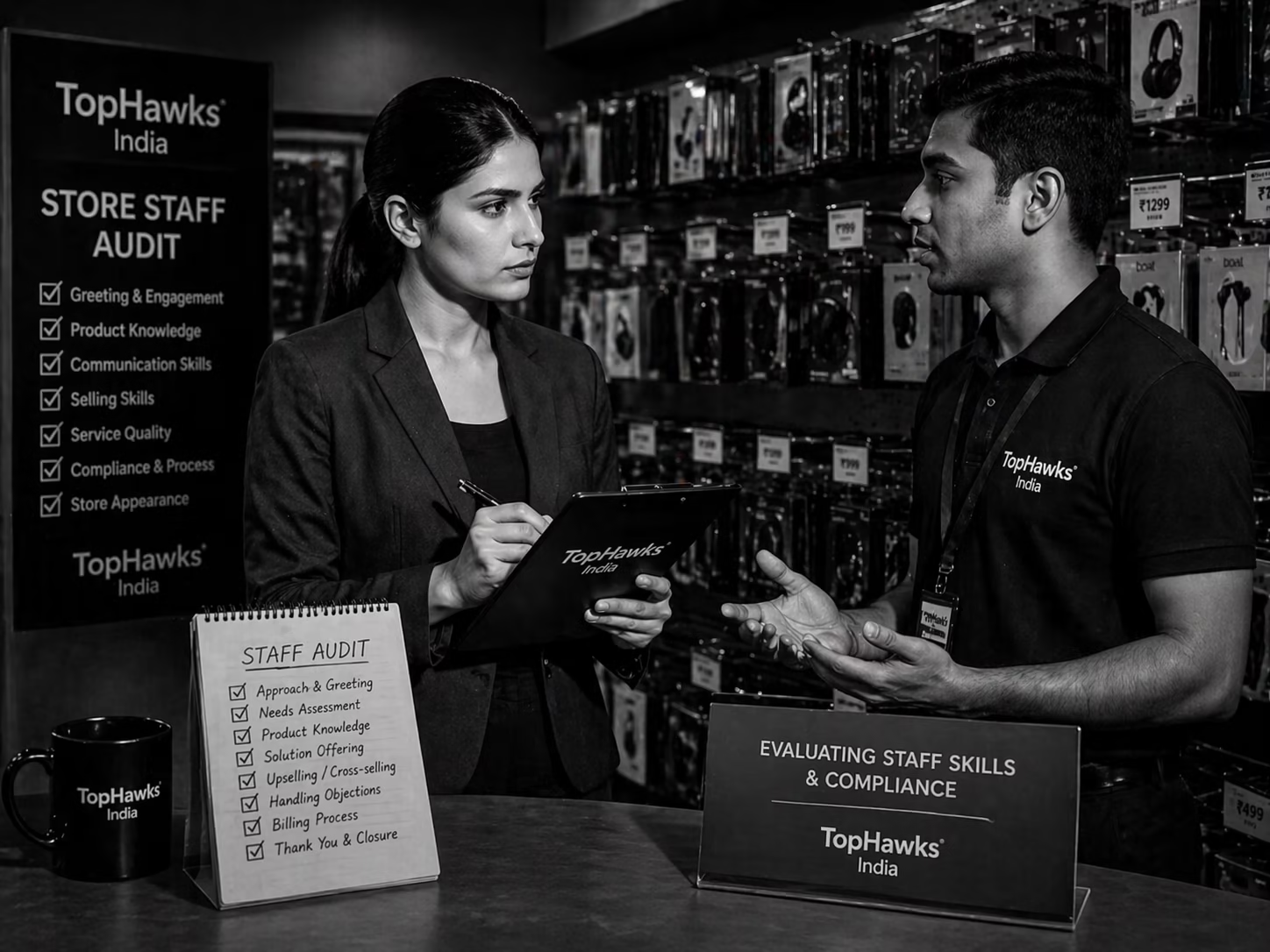
Store Staff Audit: sales skills and service standards
Frontline staff shape how customers see your brand and whether they buy. This audit looks closely at the individual: behaviour, product knowledge, selling capability and adherence to service standards during a real interaction.
Findings point to specific training needs, measure the impact of training already delivered, and show whether the right people are deployed at the right locations. See how our mystery shoppers are selected and what they evaluate.
- Presentation: grooming, hygiene and customer-facing conduct.
- Product expertise: knowledge, demonstration and feature explanation.
- Sales effectiveness: objection handling, negotiation, upselling and closing.
- Training effectiveness: before-and-after measurement of coached behaviours.
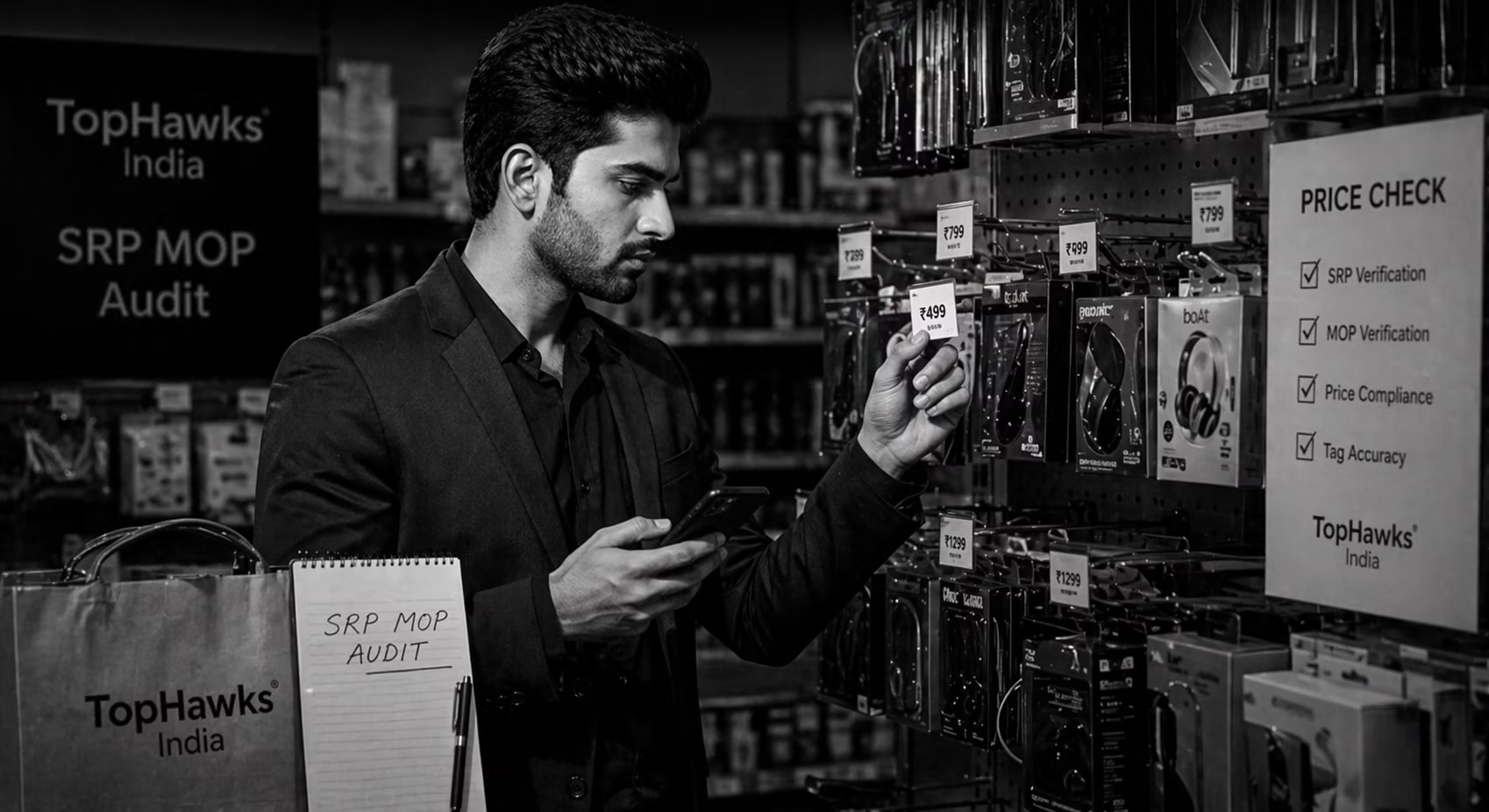
Price Check Audit: SRP and MOP compliance
Are retailers following your pricing guidelines, and how do real selling prices compare across outlets and competitors? In a Suggested Retail Price (SRP) or Market Operating Price (MOP) audit, the auditor attempts to buy the product at the best negotiated price and records the actual offer made at the counter.
Brands commission these audits for two reasons: to enforce pricing discipline across the channel, and to understand competitor pricing, schemes and offers.
- Price compliance: violations against brand pricing guidelines, by outlet.
- Competitor intelligence: competitor prices, schemes, discounts and offers.
- Channel health: inconsistent selling practices that drive price-hunting.
- Commercial input: market-level data for pricing and scheme design.
Retail Operations Audit: fixtures, signage and SOP compliance
A structured check of the store itself. Auditors verify whether fixtures, furniture, signage, branded displays and promotional material are present, correctly placed and maintained, and whether the outlet follows your standard operating procedures.
Every exception is photographed, so brand and trade-marketing teams can see the gap and confirm the fix. The Google Pixel programme below is an example of this audit type.
- Visibility: displays, planogram and promotional material against the agreed standard.
- Assets: condition of fixtures, furniture and signage.
- Procedures: store readiness and SOP adherence.
- Evidence: photo proof for each exception, scored by location.
Use it when
- You pay for in-store visibility and need proof it is live.
- A launch or campaign has to be verified across the network.
You receive
- Compliance score per outlet
- Photo-backed exception list
- City and regional roll-ups
Stock Audit: availability, accuracy and shrinkage
An on-site count and condition check of inventory at stores, distributors or stock points. Auditors compare physical stock with records, check availability and freshness, and flag indicators of shrinkage.
The result supports accurate accounting and gives sales and supply-chain teams a location-wise view of where stock control is slipping. The Eastman programme below combined stock and visibility audits.
- Accuracy: physical count against recorded inventory.
- Availability: out-of-stock and low-stock positions.
- Condition: product freshness and quality.
- Shrinkage: discrepancies by category and location.
Use it when
- Book stock and shelf stock do not match.
- You need an independent count at distributors or dealers.
You receive
- Variance report per location
- Category-level shrinkage view
- Freshness and condition exceptions
E-Commerce Seller Audit: marketplace compliance
A check of how your products are sold online. Auditors review marketplace listings and seller practices against the requirements you define: product information, presentation standards, pricing and other commercial terms.
It gives brand and channel teams a seller-by-seller record of who is compliant and who is not, with the listing evidence attached.
- Listings: product information and presentation against your standard.
- Sellers: adherence to agreed commercial and listing requirements.
- Visibility: how products appear to shoppers on the marketplace.
- Evidence: a dated record for each finding.
Use it when
- Online sellers deviate from agreed listings or prices.
- You need a regular compliance record across marketplaces.
You receive
- Seller-wise compliance status
- Listing exceptions with evidence
- Repeat-audit comparison
Which audit do you need?
Start from the business problem, then pick the method. Different problems need different evidence.
| If you need to… | Use | What gets evaluated |
|---|---|---|
| Understand the actual customer experience | Mystery Shopping | Staff interaction, service quality, product knowledge, customer handling and billing. |
| Identify staff training needs | Store Staff Audits | Grooming, communication, product knowledge and selling behaviour. |
| Find pricing deviations | Price Check Audits (SRP/MOP) | Actual selling prices against SRP and MOP guidelines, plus competitor offers. |
| Check store standards and procedures | Retail Operations Audits | Fixtures, signage, displays, store presentation and SOP compliance. |
| Verify inventory | Stock Audits | Stock accuracy, availability, freshness and indicators of shrinkage. |
| Assess online seller compliance | E-Commerce Seller Audits | Marketplace listings, product information and seller practices. |
For how findings are documented, read Everything You Need to Know About Mystery Shopping & Audit Reports.
How does a mystery shopping programme work, from brief to corrective action?
A programme runs in eight steps: define the objective, set the scope, design the scorecard, brief the shoppers, run the visits, validate the evidence, report the findings, then re-audit to confirm the fix. TopHawks starts fieldwork within 7 days of the purchase order.
Define the objective
Name the question the programme must answer, such as whether staff explain products accurately or follow the selling process, and which findings need management action.
Set locations and scope
Choose the outlets, cities and touchpoints. Plan enough visits per outlet to separate a pattern from a one-off, and rotate days and times across peak and quiet hours.
Design the scorecard
Turn each standard into an observable check: greeting, questions asked, offer made, close attempted, billing. Weight items by their link to revenue or brand standards, and define critical failures separately.
Select and brief shoppers
Match shoppers to the customer profile. Give each a believable scenario, the questions to ask, the evidence to capture and what must never be disclosed. Vary scenarios so staff cannot spot a pattern.
Run the visits
Shoppers visit and record observations in the reporting app with photographs, geolocation and timestamps, plus audio or video recordings where the programme calls for them. Recording and photography happen only where permitted and appropriate.
Validate every submission
Reviewers check location, timing, photographs and consistency between observations and scores. Anything doubtful is queried, corrected or re-fielded before it reaches you.
Report and assign action
Results are shown per location and rolled up by city, region or channel. Recurring weaknesses are separated from isolated exceptions and assigned to an owner.
Re-audit and measure
After coaching or process changes, repeat the same criteria at comparable locations and compare against the baseline. Use findings for coaching first, recognition second, penalties last.
- Start time
- Your audit starts within 7 days of the purchase order (PO).
- Real-time reporting
- Reports are live per visit, as each visit is submitted.
- Daily digest
- Our QC team collates all reports with AI-assisted analysis for each branch and emails a crisp digest every morning.
- Enquiry response
- Within 4 business hours, Monday to Saturday, 10 AM to 6 PM IST.
Read the full walkthrough in mystery audit steps and process, or see our approach to execution.
Ready to see what is really happening at your stores?
Book a 20-minute programme design call. We will map audit types, locations, checkpoints and KPIs into a practical brief.
How does TopHawks keep mystery shopping data accurate and verifiable?
Six safeguards are built in before fieldwork begins: an agreed scorecard, shopper rotation, geolocation and photo evidence, independent back-checks, clear rejection rules and a QC record shared with you. Only submissions that pass are reported.
A completed questionnaire is not automatically a trustworthy audit. Field programmes have to guard against visits that never happened, copied observations and photographs from the wrong outlet. These controls are how TopHawks does that.
Scorecard agreed before fieldwork
The questionnaire is built line by line with your team. Service standards become specific, observable, photo-verifiable checks, with scoring rules and evidence requirements fixed before any shopper is briefed.
Shopper rotation and anonymity
Rotation rules across the 1,50,000+ network are designed to stop a store meeting the same evaluator twice, which protects anonymity and objectivity.
Geolocation, timestamp and photo evidence
Check-ins are geofenced to the assigned outlet. Photographs are taken inside the app rather than uploaded from the gallery, and every response is timestamped as the visit happens. Backdated or re-used images are flagged by their date and location stamps.
Independent back-checks
A separate QA team re-verifies a percentage of completed visits in each wave, re-contacting locations where appropriate and re-scoring evidence against the original submission.
Rejection rules and re-fielding
Submissions that fail evidence, timing or consistency checks are rejected and re-fielded. Repeated photographs or implausible timings are queried with the shopper, and shopper performance is tracked over time.
QC reported with every delivery
Quality control is part of the deliverable. Validation results, exceptions and corrective actions are shared with your team, scoped per brief. Disputed scores can be re-audited with a fresh visit.
The in-house reporting app behind every audit
TopHawks programmes run on an in-house reporting app for data capture, evidence, scoring and reporting, configured to each programme's checklist and governance requirements.
- 📍 Geofenced GPS check-inConfirms the auditor is at the assigned outlet before the visit can be recorded.
- 📸 In-app camera captureGeotagged, timestamped photographs taken in the app, with no gallery uploads.
- 📶 Offline capture and syncVisits can be recorded in low-signal stores and sync when the connection returns.
- ✅ Submission validationStructured responses pass configured checks before client reporting.
- 📊 Weighted index scoringEach location is scored against programme-specific weights for fair comparison.
- 🗺️ Reporting at any levelOutlet, city, regional and national views, organised around your KPIs.
What reports and KPIs do you receive from a mystery shopping programme?
You receive outlet-level scorecards with evidence, city, regional and national summaries, a prioritised list of corrective actions, and exportable data. Reports are live per visit, with a daily digest by email.
The test of a good report: a store manager can see what to fix, a regional manager can see which outlets need attention, and national leadership can tell isolated incidents from recurring problems.
Outlet-level scorecards
- Section-wise scores across the customer journey, with photo or written evidence for each finding.
- Each outlet compared with the programme average.
- The specific behaviours and standards that need work.
City, regional and national summaries
- Scores and spread by city, region and outlet format.
- Where standards are consistently weak versus occasionally missed.
- Role-based logins, so each manager sees their own outlets, their region or the national view.
Prioritised corrective actions
- The behaviours with the largest gaps and the outlets to coach first.
- Follow-up waves that track whether behaviour changed.
- Critical checks scored separately, with immediate alerts where the programme requires them.
Recognition and analysis inputs
- Structured data to support incentive and recognition programmes, when scoring rules are clear and fair.
- Exportable results for your own analysis.
- A transparent route for outlet managers to query a score.
What is inside an outlet report?
Every audited outlet gets its own report. This is what a TopHawks store report contains.
- Overall scorePoints achieved against the target, as a percentage, with the outlet, date and visit reference.
- Score by sectionActual versus target for each section, such as cleanliness, service, staff knowledge, grooming and branding.
- Question-level resultsEach question with its score and response, beside the previous visit for comparison.
- Timestamped photographsPhotos placed next to the question they support, each with its date and time.
- The shopper's accountA written narrative for every section, describing what happened in the shopper's own words.
- Critical checksMust-not-fail items, such as overcharging or incorrect process, reported in their own section.
Which mystery shopping KPIs should you track?
A single overall score rarely tells the whole story. A store can score well overall and still fail a critical service, pricing or compliance requirement. Track these ten measures.
| KPI | What it tells you | How to use it |
|---|---|---|
| Overall audit score | How a location performs against the full scorecard. | Compare locations and spot outliers. |
| Section-level score | Which stage of the customer journey is underperforming. | Target the stage that needs intervention. |
| SOP compliance | Whether required procedures are followed. | Prioritise missed operational and service standards. |
| Product knowledge score | Whether staff give accurate, relevant product information. | Define focused training. |
| Selling behaviour compliance | Whether staff recommend, demonstrate, handle objections and close. | Direct sales coaching to the missed steps. |
| Pricing compliance | Whether observed prices meet pricing policy. | Investigate deviations with sales or channel partners. |
| Retail visibility compliance | Whether displays, signage and fixtures are present and maintained. | Correct merchandising and verify the fix. |
| Stock accuracy | Whether recorded and observed inventory match. | Investigate discrepancies and availability gaps. |
| Evidence completeness | Whether all mandatory responses and evidence were submitted. | Judge how reliable a submission is. |
| Repeat audit score | Whether performance changed after corrective action. | Measure improvement against the baseline. |
See a sample scorecard before you decide
Ask for a redacted outlet scorecard and report so your team can judge the evidence and level of detail for themselves.
What have TopHawks audit programmes delivered?
Two published case studies with named clients, defined requirements and documented findings.
Google Pixel: 35% improvement in retail execution
Systematic store-level visibility audits across India's modern trade network. Fixture compliance scoring, structured observations and geotagged photo evidence gave Google a clear view of Pixel's retail brand health, and a documented 35% improvement in retail execution.
Eastman: visibility and stock audits across the retail and distribution network
Structured visibility audits and stock reconciliation across Eastman's retail and distribution network. Display compliance checks, stock accuracy verification and category-level shrinkage monitoring produced actionable supply-chain insights.
More programmes delivered
- Global IT hardware manufacturerMOP (price), staff grooming and fixtures audits across 206 exclusive brand stores and 2,800 modern and general trade stores in 280 cities.
- Leading consumer durables manufacturerVisibility audits of signage and point-of-sale material in 2,000 stores across 90 cities, with competitor brand-space tracking.
What clients say
TopHawks delivered an outstanding mystery audit for our Marlboro Price Dipstick Program. Precise, professional, and insightful — a clear 5/5.
The Cleanliness, Visibility and Billing audits carried out by TopHawks were thorough and well-executed. Their reports were clear, detailed and very useful for us.
TopHawks conducted our branch audits with exceptional thoroughness and professionalism.
Trusted by 800+ brands across India
From global multinationals to high-growth Indian consumer brands, TopHawks supports field execution across mystery shopping, retail audits, sales outsourcing, staffing and brand activation. The brands below are part of TopHawks' wider portfolio. Individual engagements may involve different services and are mystery shopping assignments only where stated.


Mystery shopping vs internal audits vs customer feedback: which should you use?
Use all three, for different jobs. Customer feedback and NPS show how shoppers feel. Internal audits check routine compliance. Mystery shopping shows what employees actually do in a real interaction, judged by an independent observer.
| Method | Measures well | Limits | Best for |
|---|---|---|---|
| Mystery shopping | Observed employee behaviour in a real interaction, scored by a trained independent observer. | Covers a sample of visits. Shows what happened, not always why. | SOP compliance, selling behaviour, service standards and competitor comparison. |
| Internal audits by your managers | Detailed operational checks and fast corrective action at low direct cost. | Visits may be expected, and familiarity with local teams can bias results. | Routine checks between independent audits. |
| Customer feedback and NPS | Satisfaction, sentiment and Net Promoter Score (NPS) trends. | Only captures customers who respond. Opinions do not establish staff behaviour. | Tracking trends and choosing issues to investigate. |
| Retail execution audits | Whether fixtures, stock, pricing and visibility match the agreed standard. | Does not capture the quality of the service interaction. | Planogram, signage, pricing accuracy and on-shelf availability. |
Recommended approach: use NPS trends to flag outlets that may be underperforming, send mystery shoppers to establish what staff actually do there, and add retail execution audits to verify the store environment, pricing and merchandising.
How do you measure the ROI of a mystery shopping programme?
Pick one revenue-linked behaviour, measure it in a baseline wave, estimate the revenue gap between your best and typical outlets, coach, then re-measure. Build the case on your own footfall, conversion and basket data, not an industry average.
- Select a revenue-linked behaviour. For example, how often sales associates offer an add-on product or attempt the close.
- Establish the baseline. Measure how often it happens across outlets in the first audit wave.
- Estimate the gap. Use the footfall, conversion rate and average basket value you already know, alongside the difference between your best and typical outlets.
- Compare benefit with cost. Check whether closing even part of the gap covers the audits, reporting and coaching.
- Re-measure after coaching. Run a second wave on the same criteria to see whether the behaviour improved, and by how much.
One caution: a higher mystery shopping score proves the behaviour improved. It does not, by itself, prove incremental revenue. Where you can, compare later audit results with outlet sales, conversion and transaction value.
Where does TopHawks run mystery shopping audits in India?
TopHawks covers Tier-1, Tier-2 and Tier-3 cities: 246+ cities across 27+ states, through one coordinated programme run from Noida, with regional hubs in Mumbai, Bengaluru and Kolkata. Coverage is confirmed against your outlet list.
As retail networks expand beyond the major metros, head office sees less of what happens at the counter, and practices followed in flagship stores are not always repeated in new outlets. Applying one scorecard everywhere lets you compare a Tier-3 store with a metro flagship on equal terms, without building a travel-heavy internal audit team.
North
Head office: Noida (Delhi NCR). Programmes across Delhi NCR and the northern states.
West
Regional hub: Mumbai. Also Pune, Ahmedabad and the wider western region.
South
Regional hub: Bengaluru. Also Hyderabad, Chennai and the wider southern region.
East
Regional hub: Kolkata. Programmes across the eastern states.
Mystery shopping by city
- Mystery shopping in Delhi NCR
- Mystery shopping in Mumbai
- Mystery shopping in Bengaluru
- Mystery shopping in Hyderabad
- Mystery shopping in Chennai
- Mystery shopping in Pune
- Mystery shopping in Kolkata
- Mystery shopping in Ahmedabad
Mystery audits by industry
How do you compare mystery shopping companies in India before choosing one?
Look past price, network size and dashboards. Ask who manages the shoppers, what evidence backs each visit, how doubtful submissions are handled, and ask to see a sample report. Agencies with direct operational control can answer all four in detail.
| Criterion | Ask | A strong answer explains |
|---|---|---|
| Geographic coverage | Which of our cities, towns and outlets can you serve? | A location-wise plan, and which locations use directly managed shoppers versus partners. |
| Field workforce | Who recruits, screens and coordinates the shoppers? | Who is accountable for shopper suitability, scheduling and visit completion. |
| Questionnaire design | How will the scorecard reflect our standards? | How objectives become observable, consistently scored criteria. |
| Shopper preparation | How are shoppers briefed on the scenario and evidence? | Assignment-specific briefing, testing and reporting instructions. |
| Evidence | What supports each visit? | Photographs, timestamps, geolocation and how each links to a finding. |
| Quality assurance | How are incomplete or doubtful submissions handled? | The checks, queries, rejection rules and re-audit triggers. |
| Reporting | What will the report show, and how do managers access it? | Views by outlet, region and category, with the evidence attached. |
| Corrective action | Can critical findings be re-audited after training? | Repeat audits measured against the baseline on the same criteria. |
| Accountability | Who handles escalations during the programme? | Named responsibilities and an escalation route. |
What should be agreed in writing before fieldwork begins?
- Coverage: the locations, outlet categories and visits per outlet.
- Methodology: the approved questionnaire, scenarios and scoring rules.
- Evidence: the photographs, geolocation and timestamps required for each visit.
- Validation: how submissions are reviewed and when they are rejected.
- Deliverables: report structure, reporting hierarchy and KPIs.
- Accountability: owners and the escalation procedure on both sides.
- Follow-up: whether repeat audits will measure corrective action.
How TopHawks fits: TopHawks has operated since 2015, serves 800+ brands and is ISO 9001:2015 certified. Network size alone guarantees nothing, so test us on your actual geography, store formats and evidence requirements. Share your outlet list, objectives and scenarios, and we will show you how we would cover them.
Mystery shopping services in India: frequently asked questions
Mystery shopping is an independent evaluation in which trained auditors visit a business as ordinary customers and score what they experience against agreed criteria. A programme has six stages: design the scorecard, select and brief auditors, run the visits, capture evidence, quality-check submissions, then report findings by outlet, region and nationally.
TopHawks covers 246+ cities and towns across 27+ states, including all Tier-1, Tier-2 and Tier-3 cities in its network. A network of 1,50,000+ shoppers and auditors supports multi-location programmes. Coverage for a specific assignment is confirmed against your outlet list, methodology and schedule.
TopHawks offers six audit programmes: mystery shopping for customer experience, store staff audits, price check audits (SRP/MOP), retail operations audits, stock audits and e-commerce seller audits. Each can run on its own, or several can be combined into one programme across the same outlet network.
TopHawks applies six safeguards: a scorecard agreed before fieldwork, shopper rotation, geofenced check-ins with in-app timestamped photographs, independent back-checks by a separate QA team, clear rejection and re-fielding rules, and a QC record shared with each delivery. Only submissions that pass these checks are reported to clients.
TopHawks uses an in-house reporting app. It handles audit scheduling, geofenced GPS check-ins, in-app geotagged photographs, timestamps, offline capture with later sync, submission validation and weighted index scoring. Reports are live per visit and roll up to outlet, city, regional and national views. The app is available on Google Play and the App Store, and was used in the Google Pixel programme.
Fieldwork starts within 7 days of the purchase order. In that week TopHawks finalises the questionnaire, selects and briefs auditors and configures reporting. The schedule for large multi-city rollouts is agreed in the brief. For an urgent pilot, email mysteryshopping@tophawks.com with your locations, objectives and target dates.
The cost of mystery shopping depends on the programme, so TopHawks quotes against your brief. The main cost drivers are the number of outlets and cities, visits per outlet, how complex the scenario and questionnaire are, any purchase the shopper must make, the evidence required and the depth of reporting. Share your outlet list and objectives for a costed proposal.
Set the frequency by risk and by how fast you can act on findings. Start with a baseline wave, then repeat after coaching or process changes. Audit more often where compliance is critical, where outlets keep failing, or after a product launch or new sales process. Leave enough time between waves to fix what was found.
Yes. A programme keeps a common core, such as greeting, engagement and professionalism, and adds format-specific checks: demonstrations in experience stores, navigation and availability in large formats, ordering and hygiene in quick-service restaurants, complaint handling in service centres. Keeping the two sets separate preserves fair comparison across the network.
Yes, when the requirement spans several areas, for example service, availability, presentation and pricing across the same outlets. Define the primary objective first, then add secondary criteria, and score each dimension separately so a strong result in one area cannot hide a critical failure in another.
Reports show which specific behaviours are missing, such as discovery questions, demonstrations, objection handling or the close, instead of a single service score. Training teams turn those gaps into targeted coaching, and a follow-up wave checks whether the behaviour changed. It is a measure, coach, verify and improve cycle.
Follow a documented process: verify the evidence, classify the risk, assign an owner, record the corrective action and deadline, then confirm closure, with a repeat audit if needed. Critical findings should go through your escalation procedure immediately, not wait for the next reporting cycle. The audit documents the deviation, and management decides the action.
Use the same core questions, scoring weights and evidence rules everywhere, and agree them before fieldwork. Document format-specific criteria separately and compare like with like. Always read outlet scores alongside city and regional averages, because an average can hide a serious problem at one location.
Share your business objective, the outlet list with cities and formats, the audit types you need, any existing standards or checklists, required customer scenarios, evidence requirements, launch dates and reporting needs. Most important, say which decisions the results must support. TopHawks replies to enquiries within 4 business hours, Monday to Saturday, 10 AM to 6 PM IST.
Yes. A mystery audit can follow a customer journey that never enters a store. The auditor raises a web or phone enquiry, then scores how quickly the call back came, whether the advisor explained the product and documents, how the appointment was booked and how the home sales visit was conducted.
Guides and resources on mystery shopping in India
From audit findings to field execution
Mystery shopping shows where execution falls short. These TopHawks services fix what the audits find.
Want to become a TopHawks mystery shopper?
Join 1,50,000+ shoppers taking flexible, paid mystery shopping and audit assignments in their city.
Plan your mystery shopping programme with TopHawks
Share your industry, store locations and what you need to find out. A mystery shopping specialist will come back with the right audit approach, reporting plan and deployment timeline.
- Call
- +91 98102 99632
- Response time
- Within 4 business hours · Mon–Sat, 10 AM–6 PM IST
- Programme start
- Within 7 days of the purchase order
- Coverage
- 246+ cities · 27+ states · Pan-India
Request a free mystery audit consultation
Tell us about your requirement. We reply within 4 business hours.
🔒 Your details are kept confidential and handled under agreed confidentiality terms.