
How an On-Demand Workforce Helps in Boosting Sales: Strategy, Benefits & Best Practices (2026)
Quick Answer
An on-demand workforce helps boost sales by giving businesses instant access to trained, flexible sales professionals — without the fixed cost, hiring delay, or infrastructure overhead of permanent employees. Companies deploy on-demand sales staff to enter new markets faster, capitalise on short-term revenue opportunities, cover seasonal demand spikes, and test new geographies before committing to permanent headcount. The cost savings from eliminating infrastructure, equipment, training, and benefits programmes allow businesses to reinvest in sales strategy and competitive pricing — directly improving revenue.
4 Variables to Define Before Deploying an On-Demand Sales Workforce:
- Role of the sales force — what specific sales activities will they perform (cold outreach, field visits, distributor engagement, closures)?
- Size of the sales force — how many on-demand reps are needed for the target market size, geography, and revenue goal?
- Degree of specialisation — should reps be generalists or specialists in a specific product, channel, or customer type?
- Effort allocation — how should time and activity be divided across customers, products, regions, and sales activities?
You probably have heard the term freelancing or outsourcing or our transition into a gig economy. We are indeed ushering into a new era where services will be provided on-demand as we leave the traditional full-time job model behind us. Businesses have started harnessing the power of an on-demand workforce to scale up faster. To build a sustainable model for the future, a business must leverage this growing resource to build cohesive teams. Efficiency would increase by leveraging a worker’s top skillset and speeding up the turnover cycle fostering growth.

A start-up that doesn’t have the infrastructure in place to support growth can hire a freelance workforce to achieve its short-term goals. This approach can buy time to make better long-term decisions and earning immediate revenue that can be used to fund expansion later.
Whenever work is outsourced, specific goals need to be communicated clearly. If a company were to hire an on-demand sales workforce, it needs to determine the role of the sales force, the size of the sales force, their degree of sales force specialization, and how to apportion its efforts among different customers, products, and activities. Determining these critical variables will be the key factor affecting the companies’ revenue, costs, and profits.
Companies should track performance closely and quickly terminate agreements with agents that don’t perform well.

Besides cutting costs by saving on infrastructure, equipment, training, and benefit programs can allow the company to adjust selling prices in a lucrative way to boost sales and revenue. However, a rushed misstep can erase all profits which is why it is crucial to have the right tools for monitoring the freelancers and holding them accountable.

While expanding to new markets and targeting a new sales base, companies with an inflexible workforce may crumble. When companies identify profitable high-volume activities that are directly linked to customer acquisition or sales, waiting on the traditional hiring process can result in a significant loss in revenue and sales. By connecting with several independent free agents who are immediately available to start working and a platform designed to meet your needs can help capitalize on such opportunities.
Of course, the traditional full-time employee model is necessary to nurture a high-trust work culture in the long run. Total outsourcing of all activities can prove detrimental to the company in the long run as managing a large remote workforce can turn out to be tedious and time-consuming without having proper systems of communication and management, So the companies that manage to achieve a blend between the traditional workforce and the new age on-demand workforce will be the most successful.
Benefits of an on-demand workforce.
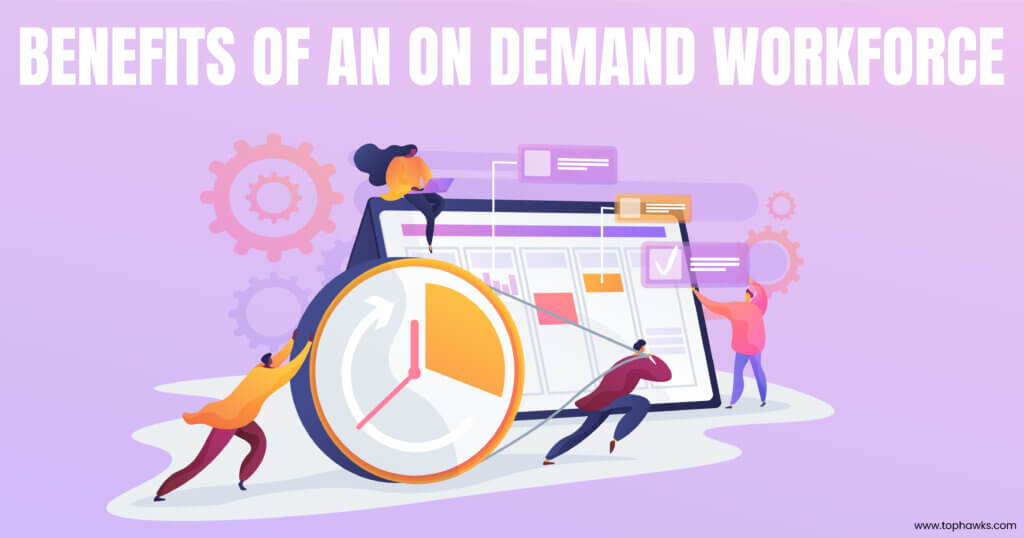
Benefits of resources, timing, and risk mitigation can be leveraged by harnessing the power of an on-demand workforce. Traditional full-time employees also require health care and other benefits whereas hiring independent professionals for specific projects can save up that cost resulting in lower employment costs. Employers can hire niche professionals for a specific term goal without disrupting the normal workflow of regular employees.
6 Ways an On-Demand Workforce Boosts Sales — At a Glance
| # | Benefit | How It Boosts Sales | India Business Context |
|---|---|---|---|
| 1 | Instant Scalability | Deploy additional sales reps within days — not the weeks or months required for permanent hiring — to capture time-sensitive revenue opportunities | Critical for FMCG and electronics brands ramping field sales coverage ahead of festive season (Diwali, Navratri) or major product launches |
| 2 | Reduced Employment Costs | Eliminate expenses for healthcare, PF, ESIC, gratuity, training, and infrastructure — reinvest those savings into sales strategy, competitive pricing, or market expansion | Particularly valuable for startups and SMEs that cannot afford the full employment cost of a pan-India permanent field sales team |
| 3 | New Market Entry Speed | Enter new geographies using an agency's existing local workforce — without setting up offices, recruiting locally, or waiting for training cycles to complete | Ideal for brands expanding from metros to tier-2 and tier-3 Indian cities (Jaipur, Lucknow, Patna, Bhopal) where building a local permanent team takes 6–12 months |
| 4 | Access to Niche Expertise | Hire specialists (channel sales experts, FMCG distributor managers, telecom product specialists) for specific revenue targets without a long-term salary commitment | Useful for B2B product companies entering retail distribution for the first time — access to reps with existing retailer and distributor relationships |
| 5 | Performance-Based Accountability | On-demand agreements can be terminated quickly for non-performance — unlike permanent employees, where dismissal is time-consuming and legally complex | Companies track daily sales reports and KPIs in real time; non-performing agents are replaced without the HR and legal overhead of permanent staff |
| 6 | Risk Mitigation in Uncertain Markets | Test new products, channels, or geographies with a flexible workforce — scale back immediately if the market doesn't respond without sunk employment costs | Particularly valuable for international brands entering India for the first time — test market response in 2–3 cities before committing to a national permanent sales structure |
The Optimal Model: Permanent + On-Demand Hybrid Workforce
| Workforce Type | Best Used For | What It Provides |
|---|---|---|
| Permanent Sales Team | Core account management, strategic relationships, brand stewardship, long-term distributor partnerships | High-trust culture, institutional knowledge, consistent brand representation, deep customer relationships |
| On-Demand Sales Workforce | Market expansion, seasonal campaigns, product launches, geographic coverage extension, short-term revenue spikes | Instant scalability, cost flexibility, niche expertise on demand, rapid market entry without permanent overhead |
Conclusion.
A simple assessment can reveal if investment in an on-demand workforce is cost-effective or not as compared to hiring full-time employees. You will need to analyze your current position to see if freelance workers could fulfill your requirement of ramping up the sales revenue. It is evident that there is a wave of talent prepared and eager for more flexible work and the economy is turning towards a gig model as most businesses start to leverage this resource at an unprecedented rate. It would be ignorant to not plug into the gig economy.
Frequently Asked Questions: On-Demand Workforce for Sales
Trusted by 500+ Clients






Get in Touch
We are here for you, and we are wearing our thinking caps